Nagpur: Difference between revisions
CSV import |
CSV import |
||
| Line 29: | Line 29: | ||
{{Indian cities}} | {{Indian cities}} | ||
{{food-stub}} | {{food-stub}} | ||
<gallery> | |||
File:Deekshabhoomi - panoramio.jpg|Deekshabhoomi | |||
File:General Post Office, Nagpur.jpg|General Post Office, Nagpur | |||
File:BAPS Swaminarayan Temple, Nagpur.jpg|BAPS Swaminarayan Temple, Nagpur | |||
File:Vidhan Bhavan (State Legislative Assembly) Nagpur - panoramio.jpg|Vidhan Bhavan (State Legislative Assembly) Nagpur | |||
File:Zero Mile The Geographical Center of India.jpg|Zero Mile The Geographical Center of India | |||
File:Nagpur Night.jpg|Nagpur Night | |||
File:Panoramic view of VCA stadium,nagpur.jpg|Panoramic view of VCA stadium, Nagpur | |||
File:Nag River reflecting urban pollution.jpg|Nag River reflecting urban pollution | |||
File:Gond king of nagpur.jpg|Gond king of Nagpur | |||
</gallery> | |||
Latest revision as of 17:49, 3 March 2025
Nagpur is the third largest city and the winter capital of the Maharashtra state in India. It is known for its rich history, culture, and its significant role in the economy of the region. Nagpur is also famous for its oranges, which have earned it the nickname "Orange City".
History[edit]
Nagpur was founded in the early 18th century by the Gond King Bakht Buland Shah of Deogarh. In the 19th century, the British East India Company took over Nagpur and made it the capital of the Central Provinces and Berar. After the independence of India, Nagpur became the capital of Madhya Pradesh state, and later, in 1960, it became a part of the newly formed Maharashtra state.
Geography[edit]
Nagpur is located at the exact center of the Indian peninsula. The city has a tropical wet and dry climate with dry conditions prevailing for most of the year. It is situated on the Deccan plateau of the Indian subcontinent and has an average elevation of about 310 meters.
Economy[edit]
The economy of Nagpur is one of the fastest growing in India. The city is an important center for IT and industries, with the Multi-modal International Cargo Hub and Airport at Nagpur (MIHAN) being a significant economic driver. Nagpur is also known for its large-scale orange cultivation, and the city's oranges are exported across the world.
Culture[edit]
Nagpur is a melting pot of cultures, with influences from the Vidarbha, Marathi, and South Indian cultures. The city is known for its literature, art, music, and dance. Nagpur hosts a variety of cultural events throughout the year, including the Orange City Craft Mela and Folk Dance Festival.
Education[edit]
Nagpur is home to several renowned educational institutions. The Nagpur University, established in 1923, is one of the oldest in the country. The city also houses the Indian Institute of Information Technology (IIIT), National Law University, and several other prominent colleges and schools.
Transport[edit]
Nagpur is well-connected by road, rail, and air. The city is a major junction for roadways and railways, and the Dr. Babasaheb Ambedkar International Airport connects Nagpur to several domestic and international destinations.
See also[edit]
 State of Maharashtra State of Maharashtra |
||||||||||
|---|---|---|---|---|---|---|---|---|---|---|
|
| Cities in India | ||||||
|---|---|---|---|---|---|---|
This Indian cities related article is a stub.
|

-
 Deekshabhoomi
 -
 General Post Office, Nagpur
 -
 BAPS Swaminarayan Temple, Nagpur
 -
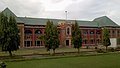 Vidhan Bhavan (State Legislative Assembly) Nagpur
 -
 Zero Mile The Geographical Center of India
 -
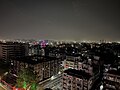 Nagpur Night
 -
 Panoramic view of VCA stadium, Nagpur
 -
 Nag River reflecting urban pollution
 -
 Gond king of Nagpur


_Nagpur_-_panoramio.jpg)


