Stereotactic surgery: Difference between revisions
CSV import Tags: mobile edit mobile web edit |
CSV import |
||
| Line 30: | Line 30: | ||
[[Category:Neurosurgery]] | [[Category:Neurosurgery]] | ||
{{stub}} | {{stub}} | ||
<gallery> | |||
File:Brain_biopsy_under_stereotaxy.jpg|Brain biopsy under stereotaxy | |||
File:Dr._B._K._Misra_performing_Stereotactic_Gamma_Radiosurgery.jpg|Dr. B. K. Misra performing Stereotactic Gamma Radiosurgery | |||
File:Frame_for_Stereotactic_Thalamotomy_on_display_at_the_Glenside_Museum.JPG|Frame for Stereotactic Thalamotomy on display at the Glenside Museum | |||
File:Desenvolvimento-TM.jpg|Stereotactic surgery | |||
File:Jorge_Schvartz.png|Stereotactic surgery | |||
File:Equipamento_Estereotaxico_ETM01-B_(Teixeira-Martos,_Hitchcock_modificado).png|Stereotactic surgery | |||
File:Equipamento_Estereotáxico_Teixeira-Martos_TM-02B.png|Stereotactic surgery | |||
File:Equipamento_Estereotáxico_Teixeira-Martos_TM-03B.png|Stereotactic surgery | |||
</gallery> | |||
Latest revision as of 12:23, 18 February 2025
Stereotactic surgery is a minimally invasive form of surgical intervention which makes use of a three-dimensional coordinate system to locate small targets inside the body and to perform on them some action such as ablation, biopsy, lesion, injection, stimulation, implantation, radiosurgery (SRS), etc.
History[edit]
The concept of stereotaxis was first introduced by Horsley and Clarke in 1908. The term "stereotactic", composed of the Greek words "stereos" meaning three-dimensional and "taxis" meaning order, was coined by the British neurosurgeon Victor Horsley and the physiologist Robert H. Clarke.
Procedure[edit]
In stereotactic surgical procedures, the surgeon uses a three-dimensional imaging technique such as computed tomography (CT), magnetic resonance imaging (MRI), or positron emission tomography (PET) to guide the insertion of an instrument or the emission of radiation in a specific area of the body.
Applications[edit]
Stereotactic surgery has a wide range of applications, including the treatment of Parkinson's disease, epilepsy, and certain types of cancer. It is also used in neurosurgery for the treatment of brain tumors and other brain disorders.
Advantages[edit]
The main advantage of stereotactic surgery is its precision. It allows the surgeon to target a specific area of the body with minimal damage to surrounding tissues. This results in less pain and a quicker recovery time for the patient.
Risks[edit]
As with any surgical procedure, stereotactic surgery carries some risks. These may include infection, bleeding, and damage to surrounding tissues. However, the risks are generally lower than with traditional open surgery.
See also[edit]
- Neurosurgery
- Radiosurgery
- Computed tomography
- Magnetic resonance imaging
- Positron emission tomography
References[edit]
<references />
 | |
|---|---|
 |
 |
-
 Brain biopsy under stereotaxy
 -
 Dr. B. K. Misra performing Stereotactic Gamma Radiosurgery
 -
 Frame for Stereotactic Thalamotomy on display at the Glenside Museum
 -
 Stereotactic surgery
 -
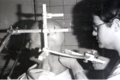 Stereotactic surgery
 -
 Stereotactic surgery
 -
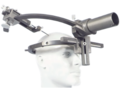 Stereotactic surgery
 -
 Stereotactic surgery


.png)


