Riot control: Difference between revisions
CSV import |
CSV import |
||
| Line 28: | Line 28: | ||
{{stub}} | {{stub}} | ||
== Riot control == | |||
<gallery> | |||
File:USMC-110306-M-5797H-224.jpg|USMC-110306-M-5797H-224 | |||
File:Place_de_la_Concorde_6_février_1934.jpg|Place de la Concorde 6 février 1934 | |||
File:Shanghai_1928_Bund_Cenotaph.jpeg|Shanghai 1928 Bund Cenotaph | |||
File:Geogia_National_Guard,_Atlanta_Police_and_Black_Lives_Matter_detail,_from-_Hold_the_Line_-_49964334728_(cropped).jpg|Georgia National Guard, Atlanta Police and Black Lives Matter detail, from: Hold the Line | |||
File:tanqueta.jpg|Tanqueta | |||
File:Polish_State_Police_(Policja_Państwowa)_before_1939.JPG|Polish State Police (Policja Państwowa) before 1939 | |||
File:Bastille_2007-05-06_anti_Sarkozy_487645689_c9fce856e3_o.jpg|Bastille 2007-05-06 anti Sarkozy | |||
File:Bastille_2007-05-06_anti_Sarkozy_487623928_37656cd319_o.jpg|Bastille 2007-05-06 anti Sarkozy | |||
File:Vietnamprotestors.jpg|Vietnam protestors | |||
File:VOA_Arrott_-_A_View_of_Syria,_Under_Government_Crackdown_07.jpg|A View of Syria, Under Government Crackdown | |||
File:Warszawa,_Marsz_Niepodległości_2011_05.jpg|Warszawa, Marsz Niepodległości 2011 | |||
File:Riot_police_by_the_building_of_the_Cabinet_of_Ministers.jpg|Riot police by the building of the Cabinet of Ministers | |||
</gallery> | |||
Latest revision as of 21:08, 23 February 2025
Riot control refers to the measures used by police, military, or other security forces to control, disperse, and arrest people who are involved in a riot, demonstration, or protest. If a riot is spontaneous and irrational, actions which cause people to stop and think for a moment (e.g. loud noises or issuing instructions in a calm tone) can be enough to stop it. However, these methods usually fail when there is severe anger with a legitimate or perceived cause, or when the riot was planned or organized. Law enforcement officers or military personnel have long used less lethal weapons such as batons and whips to disperse crowds and detain rioters.
History[edit]
The first use of the term "riot control" dates back to 1968 when it was used by police to describe police responses to riots. Riot control methods have become increasingly sophisticated over time, with advances in protective equipment such as helmets with face visors, gas masks and body armor for the police.
Methods[edit]
Riot control tactics are designed to disperse the crowd and minimize injuries. Common methods include: show of force, formation tactics, hit and run tactics, infiltration tactics, perimeter tactics, extraction tactics, and negotiation tactics.
Less-lethal weapons[edit]
Less-lethal weapons are used for riot control, including: batons, pepper spray, tear gas, water cannons, sound cannons, and rubber bullets.
See also[edit]
References[edit]
<references />
External links[edit]
 | This medical article is a stub. You can help WikiMD by expanding the page. |
Riot control[edit]
-
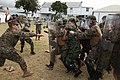 USMC-110306-M-5797H-224
 -
 Place de la Concorde 6 février 1934
 -
 Shanghai 1928 Bund Cenotaph
 -
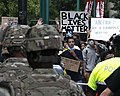 Georgia National Guard, Atlanta Police and Black Lives Matter detail, from: Hold the Line
 -
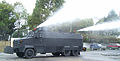 Tanqueta
 -
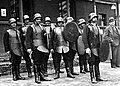 Polish State Police (Policja Państwowa) before 1939
 -
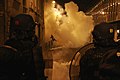 Bastille 2007-05-06 anti Sarkozy
 -
 Bastille 2007-05-06 anti Sarkozy
 -
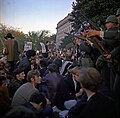 Vietnam protestors
 -
 A View of Syria, Under Government Crackdown
 -
 Warszawa, Marsz Niepodległości 2011
 -
 Riot police by the building of the Cabinet of Ministers


.jpg)

_before_1939.JPG)


