Steel: Difference between revisions
CSV import |
CSV import |
||
| Line 51: | Line 51: | ||
{{stub}} | {{stub}} | ||
{{dictionary-stub1}} | {{dictionary-stub1}} | ||
<gallery> | |||
File:Steel_wire_rope.JPG|Steel wire rope | |||
File:Blacksmithing_at_the_2015_Fort_Ross_Festival_-_Fort_Ross_State_Historic_Park_-_Jenner,_California_-_Sarah_Stierch.jpg|Blacksmithing at the 2015 Fort Ross Festival | |||
File:Steel_Fe-C_phase_diagram-en.png|Steel Fe-C phase diagram | |||
File:LightningVolt_Iron_Ore_Pellets.jpg|Iron ore pellets | |||
File:Bas_fourneau.png|Blast furnace | |||
File:Bessemer_Converter_Sheffield.jpg|Bessemer Converter Sheffield | |||
File:Siemens_Martin_Ofen_Brandenburg.jpg|Siemens Martin furnace Brandenburg | |||
File:Allegheny_Ludlum_steel_furnace.jpg|Allegheny Ludlum steel furnace | |||
File:Steel_production_by_country_map_2023.png|Steel production by country map 2023 | |||
File:Bethlehem_Steel.jpg|Bethlehem Steel | |||
File:Alcator_C-Mod_superstructure_forging_1.jpg|Alcator C-Mod superstructure forging | |||
</gallery> | |||
Latest revision as of 21:06, 23 February 2025
Steel is an alloy made primarily of iron with carbon being the primary alloying material. Additional elements may also be present in varying quantities, such as manganese, silicon, and vanadium. Small amounts of carbon, typically between 0.2 and 2.1 percent, are used in steel to improve its hardness and strength.
Steel is one of the most commonly used materials in the world, with applications ranging from construction and infrastructure to appliances and vehicles. It is known for its high tensile strength and low cost, which make it a major component used in buildings, infrastructure, tools, ships, automobiles, machines, appliances, and weapons.
History[edit]
The production of steel dates back to 1800 BC in the eastern Mediterranean region. However, it was not until the 17th century that the process of cementation was developed in England, which involved heating bars of iron with charcoal in sealed clay tubes. This process produced a surface of blister steel, which could then be hammered to produce crucible steel.
In the 19th century, the Bessemer process was developed, which allowed for the mass production of steel. This process involved blowing air through molten iron to burn off impurities and excess carbon. The Bessemer process was later replaced by the basic oxygen process and the electric arc furnace process, both of which are still used today.
Types of Steel[edit]
There are several different types of steel, each with its own unique properties and uses. These include:
- Carbon Steel: This is the most common type of steel and is composed primarily of iron and carbon. It is known for its high tensile strength and is often used in construction and industrial applications.
- Alloy Steel: This type of steel contains additional elements such as nickel, chromium, and molybdenum, which give it enhanced properties such as increased strength and corrosion resistance.
- Stainless Steel: This is a type of steel that contains at least 10.5% chromium, which gives it a high resistance to corrosion. It is often used in kitchen utensils, surgical instruments, and industrial equipment.
- Tool Steel: This type of steel is known for its hardness and is often used to make cutting tools, dies, and molds.
Production[edit]
The production of steel involves several steps, including the extraction of iron ore, the smelting of the ore to produce pig iron, and the refining of the pig iron to produce steel. The refining process involves the removal of impurities and the addition of alloying elements to give the steel its desired properties.
Uses[edit]
Steel is used in a wide variety of applications due to its strength, durability, and versatility. Some of the most common uses of steel include:
- Construction: Steel is used in the construction of buildings, bridges, and other structures due to its high strength and durability.
- Automotive Industry: Steel is used in the production of cars, trucks, and other vehicles due to its strength and ability to be formed into complex shapes.
- Appliances: Many household appliances, such as refrigerators, ovens, and washing machines, are made from steel.
- Tools and Machinery: Steel is used in the production of a wide variety of tools and machinery due to its hardness and durability.
See Also[edit]
 | |
|---|---|
 |
 |
-
 Steel wire rope
 -
 Blacksmithing at the 2015 Fort Ross Festival
 -
 Steel Fe-C phase diagram
 -
 Iron ore pellets
 -
 Blast furnace
 -
 Bessemer Converter Sheffield
 -
 Siemens Martin furnace Brandenburg
 -
 Allegheny Ludlum steel furnace
 -
 Steel production by country map 2023
 -
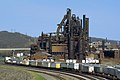 Bethlehem Steel
 -
 Alcator C-Mod superstructure forging


