Inferior colliculus: Difference between revisions
CSV import |
CSV import |
||
| Line 28: | Line 28: | ||
[[Category:Auditory system]] | [[Category:Auditory system]] | ||
[[Category:Midbrain]] | [[Category:Midbrain]] | ||
<gallery> | |||
File:Inferior_colliculus_-_sagittal_cut.jpg|Inferior colliculus - sagittal cut | |||
File:Gray711.png|Inferior colliculus | |||
File:Inferior_colliculus_of_the_human_midbrain.svg|Inferior colliculus of the human midbrain | |||
File:Gray682.png|Inferior colliculus | |||
File:Gray685.png|Inferior colliculus | |||
File:Gray691.png|Inferior colliculus | |||
File:Gray719.png|Inferior colliculus | |||
File:Human_brainstem-thalamus_posterior_view_description.JPG|Inferior colliculus | |||
File:Slide2PITER.JPG|Inferior colliculus | |||
File:Slide2BRA.JPG|Inferior colliculus | |||
</gallery> | |||
Latest revision as of 11:27, 18 February 2025
Inferior colliculus is a part of the midbrain that plays a crucial role in the processing of auditory information. It is one of the main components of the auditory pathway in the mammalian brain, serving as a hub for the convergence and integration of auditory information from various sources.
Anatomy[edit]
The inferior colliculus is located in the tectum of the midbrain, dorsal to the cerebral peduncles. It is a paired structure, with one located in each hemisphere of the brain. Each inferior colliculus is divided into two main parts: the central nucleus and the surrounding pericentral nucleus.
Function[edit]
The primary function of the inferior colliculus is to process and relay auditory information to the thalamus, which then sends this information to the auditory cortex for further processing. The inferior colliculus receives input from several lower auditory brainstem nuclei, including the cochlear nuclei, the superior olivary complex, and the nucleus of the lateral lemniscus.
Clinical significance[edit]
Damage to the inferior colliculus can result in a variety of auditory deficits, including difficulties with sound localization and auditory space perception. It can also lead to tinnitus, a condition characterized by the perception of sound in the absence of any external auditory stimulus.
See also[edit]
References[edit]
<references />
 | |
|---|---|
 |
 |
-
 Inferior colliculus - sagittal cut
 -
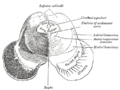 Inferior colliculus
 -
 Inferior colliculus of the human midbrain
 -
 Inferior colliculus
 -
 Inferior colliculus
 -
 Inferior colliculus
 -
Inferior colliculus
-
Inferior colliculus
-
Inferior colliculus
-
Inferior colliculus


