Marxism: Difference between revisions
CSV import |
CSV import |
||
| Line 28: | Line 28: | ||
{{stub}} | {{stub}} | ||
{{dictionary-stub1}} | {{dictionary-stub1}} | ||
<gallery> | |||
File:Karl_Marx_1871_(3x4).jpg|Karl Marx 1871 | |||
File:Friedrich_Engels_portrait_(cropped).jpg|Friedrich Engels portrait | |||
File:Pyramid_of_Capitalist_System.jpg|Pyramid of Capitalist System | |||
File:Madrid_may_day375.jpg|Madrid May Day | |||
File:Lev_Trotsky_1906-3.3_V1.jpg|Lev Trotsky 1906 | |||
File:Gordon_Childe.jpg|Gordon Childe | |||
File:Marx_and_Engels.jpg|Marx and Engels | |||
File:Lenin_in_1920_(cropped).jpg|Lenin in 1920 | |||
File:Bundesarchiv_Bild_183-R15068,_Leo_Dawidowitsch_Trotzki.jpg|Leo Dawidowitsch Trotzki | |||
File:Fidel_Castro_-_UN_General_Assembly_1960.jpg|Fidel Castro - UN General Assembly 1960 | |||
File:Hugo-Chavéz_Vota.jpg|Hugo Chávez Vota | |||
File:VISITA_DE_ESTADO_-_XI_JINPING_(30930224182).jpg|Visita de Estado - Xi Jinping | |||
</gallery> | |||
Latest revision as of 21:32, 23 February 2025
Marxism is a social, political, and economic theory originated by Karl Marx, which focuses on the struggle between capitalists and the working class. Marx believed that societal change occurs through this struggle, which he interpreted as a series of events leading to a change in the economic structure of society.
History[edit]
Marxism has its roots in the mid-19th century, when Karl Marx and Friedrich Engels published The Communist Manifesto in 1848. This document laid out their theory of history and class struggle, and it has since become one of the foundational texts of the Marxist movement.
Theory[edit]
Marxism posits that society is organized around the economy, and that the means of production (such as factories, land, and resources) are controlled by the capitalist class. The working class, or proletariat, sell their labor to the capitalists for wages. Marx argued that this system leads to exploitation, as the capitalists profit from the labor of the proletariat.
Criticism[edit]
Critics of Marxism argue that it is overly deterministic, reducing all of society to economic factors. Others argue that it fails to account for other forms of social inequality, such as race and gender. Some critics also argue that Marxist theory has been used to justify authoritarian regimes.
Influence[edit]
Despite these criticisms, Marxism has had a profound influence on a variety of fields, including sociology, economics, and political science. It has also inspired numerous social and political movements around the world.
See also[edit]
 | |
|---|---|
 |
 |
-
 Karl Marx 1871
 -
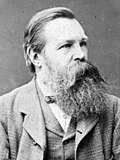 Friedrich Engels portrait
 -
Pyramid of Capitalist System
-
Madrid May Day
-
Lev Trotsky 1906
-
Gordon Childe
-
Marx and Engels
-
Lenin in 1920
-
Leo Dawidowitsch Trotzki
-
Fidel Castro - UN General Assembly 1960
-
Hugo Chávez Vota
-
Visita de Estado - Xi Jinping
.jpg)
.jpg)


.jpg)


.jpg)