Panoramic radiograph: Difference between revisions
CSV import Tags: mobile edit mobile web edit |
CSV import |
||
| Line 37: | Line 37: | ||
{{stub}} | {{stub}} | ||
<gallery> | |||
File:Panoramicfilm.JPG|Panoramic radiograph | |||
File:Mixed_dentition_pan.jpg|Mixed dentition panoramic radiograph | |||
File:Basic_panoramic_radiograph.jpg|Basic panoramic radiograph | |||
File:Panoramic_Xray.jpg|Panoramic X-ray | |||
File:PAN_TEETH.jpg|Panoramic radiograph of teeth | |||
File:Simple_mandible_fracture.jpg|Simple mandible fracture | |||
File:Stafne_defect_panorex.jpg|Stafne defect on panoramic radiograph | |||
File:JawCyst_(with_arrows).jpg|Jaw cyst with arrows | |||
File:RotatingPan.gif|Rotating panoramic radiograph | |||
File:X-ray64A.JPG|Panoramic radiograph | |||
File:X-ray65B.JPG|Panoramic radiograph | |||
</gallery> | |||
Latest revision as of 11:34, 18 February 2025
Panoramic radiograph is a type of X-ray that provides a broad view of the jaw, teeth, and other facial structures. It is commonly used in dentistry and oral surgery to diagnose and plan treatment for various conditions.
Overview[edit]
A panoramic radiograph, also known as a panorex, is a two-dimensional dental x-ray examination that captures the entire mouth in a single image. This includes the teeth, upper and lower jaws, surrounding structures and tissues. The unique feature of this type of x-ray is its ability to provide a broad view of the oral cavity, which can be useful in diagnosing problems that may not be visible with a traditional intraoral x-ray.
Uses[edit]
Panoramic radiographs are used for a variety of purposes in dentistry, including:
- Diagnosing impacted teeth
- Detecting jaw fractures
- Identifying bone loss due to periodontal disease
- Planning treatment for extensive dental implants, orthodontic treatment, and extractions
- Detecting oral cancer
Procedure[edit]
The procedure for obtaining a panoramic radiograph involves the patient standing or sitting in front of the x-ray machine with a bite-blocker placed in their mouth. The x-ray tube rotates around the patient's head, capturing images of the entire oral cavity. The process is quick, painless, and non-invasive.
Risks[edit]
As with any type of x-ray, there is a small risk of radiation exposure with panoramic radiographs. However, the amount of radiation is minimal and is considered safe for most patients. Pregnant women and individuals who have undergone radiation therapy may need to avoid this type of x-ray.
Limitations[edit]
While panoramic radiographs provide a comprehensive view of the oral cavity, they do not provide the same level of detail as intraoral x-rays. Therefore, they may not be suitable for detecting small cavities or detailed images of individual teeth.
See also[edit]
 | |
|---|---|
 |
 |
-
 Panoramic radiograph
 -
 Mixed dentition panoramic radiograph
 -
 Basic panoramic radiograph
 -
 Panoramic X-ray
 -
 Panoramic radiograph of teeth
 -
 Simple mandible fracture
 -
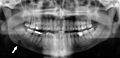 Stafne defect on panoramic radiograph
 -
 Jaw cyst with arrows
 -
 Rotating panoramic radiograph
 -
 Panoramic radiograph
 -
 Panoramic radiograph


.jpg)


