Low-carbon diet: Difference between revisions
CSV import |
CSV import |
||
| Line 35: | Line 35: | ||
{{stub}} | {{stub}} | ||
<gallery> | |||
File:Bowls_of_African_Food_Ingredients.jpg|Bowls of African Food Ingredients | |||
File:Exmouth_Arms,_Somers_Town,_London_(4092315906).jpg|Exmouth Arms, Somers Town, London | |||
File:Tacos_veganos_surtidos_03.jpg|Tacos Veganos Surtidos | |||
File:Vegetarian_Thali.jpg|Vegetarian Thali | |||
File:A_Five_selections_of_Chinese_Vegetarian_Platter_in_Hong_Kong.jpg|Five Selections of Chinese Vegetarian Platter in Hong Kong | |||
File:Global_greenhouse_gas_emissions_from_food_production.png|Global Greenhouse Gas Emissions from Food Production | |||
File:Clune2016_food_lca.svg|Clune 2016 Food LCA | |||
File:Entis_BugBites_oat_snacks_with_cultivated_cricket_flour.jpg|Entis BugBites Oat Snacks with Cultivated Cricket Flour | |||
File:climate_food_flashcards_main_nov19_v2_onepersheet.pdf|Low-carbon diet | |||
</gallery> | |||
Latest revision as of 21:34, 20 February 2025
Low-carbon diet is a dietary plan that aims to reduce the carbon footprint associated with food consumption. It is a part of the broader movement towards sustainable living and environmental conservation.
Overview[edit]
A low-carbon diet emphasizes the consumption of plant-based foods and minimizes the intake of animal products, which are associated with higher greenhouse gas emissions. This diet also encourages the consumption of locally sourced and seasonally available foods to reduce the carbon emissions associated with food transportation and storage.
Environmental Impact[edit]
The food system contributes significantly to global greenhouse gas emissions. Livestock farming, in particular, is a major source of methane, a potent greenhouse gas. By reducing the consumption of animal products, a low-carbon diet can help mitigate the environmental impact of our food choices.
Health Benefits[edit]
In addition to its environmental benefits, a low-carbon diet can also offer health benefits. Plant-based diets are associated with lower risks of heart disease, obesity, diabetes, and certain types of cancer.
Challenges[edit]
Despite its benefits, adopting a low-carbon diet can be challenging. It requires changes in eating habits and food choices, which can be difficult for some people. Moreover, access to fresh, locally sourced foods can be limited in some areas.
See Also[edit]
References[edit]
<references />
 | |
|---|---|
 |
 |
-
 Bowls of African Food Ingredients
 -
 Exmouth Arms, Somers Town, London
 -
 Tacos Veganos Surtidos
 -
 Vegetarian Thali
 -
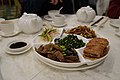 Five Selections of Chinese Vegetarian Platter in Hong Kong
 -
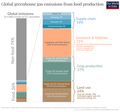 Global Greenhouse Gas Emissions from Food Production
 -
 Clune 2016 Food LCA
 -
 Entis BugBites Oat Snacks with Cultivated Cricket Flour
 -
 Low-carbon diet

.jpg)


