Syzygium samarangense: Difference between revisions
CSV import |
CSV import |
||
| Line 35: | Line 35: | ||
[[Category:Tropical fruit]] | [[Category:Tropical fruit]] | ||
[[Category:Traditional medicine]] | [[Category:Traditional medicine]] | ||
<gallery> | |||
File:Hoa_của_loài_roi.jpg|Syzygium samarangense | |||
File:Syzygium_fruit.jpg|Syzygium samarangense | |||
File:2014-04-26_Syzygium_samarangense_04_anagoria.JPG|Syzygium samarangense | |||
File:2014-04-26_Syzygium_samarangense_01_anagoria.JPG|Syzygium samarangense | |||
File:Bell_Fruit_-_%E0%B4%9A%E0%B4%BE%E0%B4%AE%E0%B5%8D%E0%B4%AA_04.JPG|Syzygium samarangense | |||
File:Taiwan_fruits.jpg|Syzygium samarangense | |||
File:Jambakai01.jpg|Syzygium samarangense | |||
File:Jambakai02.jpg|Syzygium samarangense | |||
File:Wax_apple_(Syzygium_samarangense).jpg|Syzygium samarangense | |||
File:Wax_apple_(Syzygium_samarangense)_with_leaves.jpg|Syzygium samarangense | |||
File:Wax_apple_(Syzygium_samarangense)_Tree_lower_trunk.jpg|Syzygium samarangense | |||
File:Lainwu_(Wax_apple)_diamond_P00063.JPG|Syzygium samarangense | |||
</gallery> | |||
Revision as of 12:08, 18 February 2025
Syzygium samarangense
Syzygium samarangense, also known as the Java apple, is a species of flowering plant in the family Myrtaceae. It is native to Southeast Asia and the Indian Subcontinent. The plant is known for its fruit, which is consumed in many different cultures.
Description
Syzygium samarangense is a tropical, evergreen tree that can reach up to 12 meters in height. The leaves are lanceolate, 10-25 cm long and 5-10 cm broad. The flowers are white, and the fruit is bell-shaped, waxy and shiny.
Distribution and Habitat
The Java apple is native to the Philippines, India, Indonesia, and Malaysia. It is also cultivated in many parts of the Caribbean, Central America, and South America. The tree thrives in tropical climates and is often found in rainforests and wet, coastal areas.
Cultivation
Cultivation of Syzygium samarangense requires a tropical or subtropical climate, with temperatures above 20 degrees Celsius. The tree prefers well-drained soil and requires regular watering. It is often propagated through seeds, but can also be grown from cuttings.
Uses
The fruit of the Syzygium samarangense is edible and is often eaten fresh or used in cooking. It has a crisp texture and a slightly sweet taste. In addition to its culinary uses, the tree is also used in traditional medicine in some cultures.
See Also
References
-
 Syzygium samarangense
 -
 Syzygium samarangense
 -
 Syzygium samarangense
 -
 Syzygium samarangense
 -
 Syzygium samarangense
 -
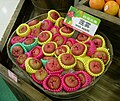 Syzygium samarangense
 -
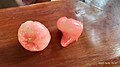 Syzygium samarangense
 -
 Syzygium samarangense
 -
 Syzygium samarangense
 -
 Syzygium samarangense
 -
 Syzygium samarangense
 -
 Syzygium samarangense


.jpg)
_with_leaves.jpg)
_Tree_lower_trunk.jpg)
_diamond_P00063.JPG)
