2,4-Dichlorophenoxyacetic acid: Difference between revisions
mNo edit summary |
CSV import |
||
| Line 1: | Line 1: | ||
== 2,4-Dichlorophenoxyacetic | {{Short description|A synthetic auxin herbicide used in agriculture and gardening}} | ||
{{Chembox | |||
| Name = 2,4-Dichlorophenoxyacetic acid | |||
| ImageFile = 2,4-Dichlorophenoxyacetic acid structure numbered.svg | |||
| ImageSize = 200px | |||
| ImageAlt = Structural formula of 2,4-D | |||
| ImageFile1 = 2,4-Dichlorophenoxyacetic-acid-3D-balls-2.png | |||
| ImageSize1 = 200px | |||
| ImageAlt1 = 3D model of 2,4-D | |||
| IUPACName = 2,4-Dichlorophenoxyacetic acid | |||
| OtherNames = 2,4-D | |||
| Section1 = {{Chembox Identifiers | |||
| CASNo = 94-75-7 | |||
| PubChem = 1486 | |||
| ChemSpiderID = 1440 | |||
| UNII = 9GJ0E4C590 | |||
| KEGG = C11047 | |||
| ChEBI = 28844 | |||
| ChEMBL = 1615 | |||
}} | |||
| Section2 = {{Chembox Properties | |||
| C = 8 | |||
| H = 6 | |||
| Cl = 2 | |||
| O = 3 | |||
| Appearance = White crystalline solid | |||
| Density = 1.563 g/cm³ | |||
| MeltingPt = 140 °C | |||
| BoilingPt = 160 °C (decomposes) | |||
}} | |||
}} | |||
'''2,4-Dichlorophenoxyacetic acid''' (commonly referred to as '''2,4-D''') is a widely used herbicide in agriculture and gardening. It is a type of synthetic auxin, which mimics the natural plant hormone auxin, leading to uncontrolled growth and eventually the death of the plant. | |||
==History== | |||
2,4-D was first developed during the 1940s and became one of the first successful selective herbicides. It was used extensively in agriculture to control broadleaf weeds without harming grasses and cereal crops. Its development marked a significant advancement in agricultural practices, allowing for more efficient weed control. | |||
== Chemical Properties == | ==Chemical Properties== | ||
2,4-D | 2,4-D is a white crystalline solid with a molecular formula of C₈H₆Cl₂O₃. It is soluble in water and has a melting point of 140 °C. The compound decomposes upon boiling. | ||
== | ==Mechanism of Action== | ||
2,4-D | 2,4-D functions as a plant growth regulator by mimicking the action of auxins, which are natural plant hormones. When applied to plants, it causes uncontrolled cell division and growth, leading to the death of susceptible plants, particularly broadleaf weeds. | ||
== | ==Applications== | ||
2,4-D is used in: | |||
* [[Agriculture]]: To control broadleaf weeds in cereal crops, pastures, and grasslands. | |||
* [[Horticulture]]: For lawn care and maintenance, controlling weeds in turf and gardens. | |||
* [[Forestry]]: To manage unwanted vegetation. | |||
==Safety and Environmental Impact== | |||
While 2,4-D is effective in controlling weeds, it has raised concerns regarding its environmental impact and potential health effects. It is important to follow safety guidelines when handling and applying 2,4-D to minimize risks to humans and non-target species. | |||
2,4-D | ==Regulation== | ||
2,4-D is regulated by various environmental and agricultural agencies worldwide. It is important for users to comply with local regulations regarding its use and application. | |||
== | ==Gallery== | ||
<gallery> | |||
File:2,4-Dichlorophenoxyacetic acid structure numbered.svg|Structural formula of 2,4-D | |||
File:2,4-Dichlorophenoxyacetic-acid-3D-balls-2.png|3D model of 2,4-D | |||
File:2-4 Dow weed killer.jpg|Commercial product containing 2,4-D | |||
File:Lantana 2-4-D effect close up.jpg|Effect of 2,4-D on Lantana | |||
</gallery> | |||
== | ==Also see== | ||
* [[Herbicide]] | |||
* [[Auxin]] | |||
* [[Weed control]] | |||
* [[Agricultural chemistry]] | |||
{{Herbicides}} | |||
{{Agricultural chemicals}} | |||
[[Category:Herbicides]] | [[Category:Herbicides]] | ||
[[Category: | [[Category:Chlorinated compounds]] | ||
[[Category: | [[Category:Plant hormones]] | ||
Latest revision as of 02:48, 11 December 2024
A synthetic auxin herbicide used in agriculture and gardening
| Chemical Compound | |
|---|---|
| Identifiers | |
| CAS Number | |
| PubChem CID | |
| ChemSpider ID | |
| UNII | |
| ChEBI | |
| ChEMBL | |
| Properties | |
| Chemical Formula | |
| Molar Mass | |
| Appearance | |
| Density | |
| Melting Point | |
| Boiling Point | |
| Hazards | |
| GHS Pictograms | [[File:|50px]] |
| GHS Signal Word | |
| GHS Hazard Statements | |
| NFPA 704 | [[File:|50px]] |
| References | |
2,4-Dichlorophenoxyacetic acid (commonly referred to as 2,4-D) is a widely used herbicide in agriculture and gardening. It is a type of synthetic auxin, which mimics the natural plant hormone auxin, leading to uncontrolled growth and eventually the death of the plant.
History[edit]
2,4-D was first developed during the 1940s and became one of the first successful selective herbicides. It was used extensively in agriculture to control broadleaf weeds without harming grasses and cereal crops. Its development marked a significant advancement in agricultural practices, allowing for more efficient weed control.
Chemical Properties[edit]
2,4-D is a white crystalline solid with a molecular formula of C₈H₆Cl₂O₃. It is soluble in water and has a melting point of 140 °C. The compound decomposes upon boiling.
Mechanism of Action[edit]
2,4-D functions as a plant growth regulator by mimicking the action of auxins, which are natural plant hormones. When applied to plants, it causes uncontrolled cell division and growth, leading to the death of susceptible plants, particularly broadleaf weeds.
Applications[edit]
2,4-D is used in:
- Agriculture: To control broadleaf weeds in cereal crops, pastures, and grasslands.
- Horticulture: For lawn care and maintenance, controlling weeds in turf and gardens.
- Forestry: To manage unwanted vegetation.
Safety and Environmental Impact[edit]
While 2,4-D is effective in controlling weeds, it has raised concerns regarding its environmental impact and potential health effects. It is important to follow safety guidelines when handling and applying 2,4-D to minimize risks to humans and non-target species.
Regulation[edit]
2,4-D is regulated by various environmental and agricultural agencies worldwide. It is important for users to comply with local regulations regarding its use and application.
Gallery[edit]
-
 Structural formula of 2,4-D
 -
 3D model of 2,4-D
 -
 Commercial product containing 2,4-D
 -
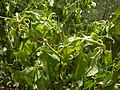 Effect of 2,4-D on Lantana


Also see[edit]
| Pest control: herbicides | ||||||||||
|---|---|---|---|---|---|---|---|---|---|---|
|
