Levonorgestrel: Difference between revisions
No edit summary |
CSV import |
||
| Line 31: | Line 31: | ||
{{gynecologic agents}} | {{gynecologic agents}} | ||
{{coststubd}} | {{coststubd}} | ||
<gallery> | |||
File:Levonorgestrel.svg|Levonorgestrel | |||
File:Levonorgestrel molecule ball.png|Levonorgestrel | |||
</gallery> | |||
Latest revision as of 01:48, 20 February 2025
Levonorgestrel is a synthetically derived progestin used primarily in emergency contraception and standard oral contraceptives. It acts as an agonist of the progesterone receptor, providing effective contraception by preventing ovulation.

Pharmacological Profile[edit]
Levonorgestrel operates as an emergency contraceptive by hindering the luteinizing hormone (LH) surge that precedes ovulation. Its efficiency is observed predominantly when administered before this LH surge, and it demonstrates minimal effects on fertilization or implantation.
Clinical Efficacy[edit]
Clinical studies have evidenced the efficacy of levonorgestrel in significantly lowering the rate of unwanted pregnancies when used within 48 hours of unprotected intercourse or suspected contraceptive failure. The overall failure rates range from 0.6% to 3.1%, compared to expected rates of 5% to 6%.
Approval and Usage[edit]
The United States Food and Drug Administration (FDA) approved levonorgestrel for emergency contraception use in 1982. Available generically and over-the-counter, it is administered in tablet form in doses of 0.75 and 1.5 mg. The recommended regimen for emergency contraception is a total dose of 1.5 mg, taken within 72 hours of unprotected intercourse or suspected contraceptive failure.
Levonorgestrel also serves as a constituent of standard oral contraceptives, where it is used alone or in combination with estrogens.
Safety Profile[edit]
The use of levonorgestrel has not been associated with liver enzyme elevations or clinically apparent liver injury with jaundice.
Adverse Effects[edit]
Potential side effects of levonorgestrel use, generally mild-to-moderate in severity, can include headache, nausea, abdominal pain, dysmenorrhea, breast tenderness, fatigue, and dizziness.
Obstetrical and Gynecological Agents[edit]
- Pregnancy termination agents
- Progesterone and the Progestins
-
 Levonorgestrel
 -
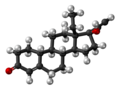 Levonorgestrel

