Bamboo: Difference between revisions
No edit summary Tags: mobile edit mobile web edit |
CSV import |
||
| Line 77: | Line 77: | ||
[[Category:Green building]] | [[Category:Green building]] | ||
{{food}} | {{food}} | ||
== Bamboo == | |||
<gallery> | |||
File:Bamboo forest.jpg|Bamboo forest | |||
File:Bamboo-yellow.jpg|Yellow bamboo | |||
File:Phyllostachys nigra folium.jpg|Phyllostachys nigra folium | |||
File:Bamboo shoot-phyllostachys parvifolia-jx1241c.jpg|Bamboo shoot | |||
File:20200704 Bamboo barrier.jpg|Bamboo barrier | |||
</gallery> | |||
Latest revision as of 00:49, 20 February 2025
Bamboo[edit]

Bamboo is a type of grass that belongs to the family Poaceae. It is native to Asia, but it is now grown in many parts of the world. Bamboo is known for its rapid growth and versatility, and it is used for a wide range of purposes, from construction to food. In this article, we will explore the history, cultivation, uses, and environmental impact of bamboo.
History[edit]
Bamboo has been used for thousands of years in Asia for a variety of purposes, including construction, food, and medicine. The first recorded use of bamboo dates back to 5,000 BCE in China, where it was used to make arrows and paper. Bamboo was also used in Japan to make swords, and in India, it was used for weaving baskets and mats.
In modern times, bamboo has become a popular material for construction and furniture due to its strength and sustainability.
Cultivation[edit]
Bamboo is a fast-growing plant that can reach maturity in just a few years. It is grown in many parts of the world, including China, India, Indonesia, and the United States. There are over 1,000 different species of bamboo, and they vary in size and color.
Bamboo is usually grown in tropical and subtropical regions, where it can receive plenty of sunlight and water. It is harvested by cutting the stems, or culms, at the base. The culms are then cut into sections and used for a variety of purposes.
Uses[edit]
Bamboo has a wide range of uses, from construction to food. Some of the most common uses of bamboo include:
Construction[edit]
Bamboo is a popular material for construction due to its strength, durability, and sustainability. It is used to make everything from houses and bridges to furniture and flooring. Bamboo is also a popular material for scaffolding, as it is lightweight and strong.
Food[edit]
Bamboo shoots are a popular ingredient in Asian cuisine. They are used in soups, stir-fries, and salads, and they are known for their crunchy texture and delicate flavor. Bamboo shoots are low in calories and high in fiber, making them a healthy addition to any diet.
Textiles[edit]
Bamboo fibers are used to make a variety of textiles, including clothing, towels, and bed sheets. Bamboo textiles are known for their softness and moisture-wicking properties, making them a popular choice for activewear and bedding.
Paper[edit]
Bamboo is used to make a variety of paper products, including tissue paper, toilet paper, and notebook paper. Bamboo paper is known for its strength and durability, and it is a more sustainable alternative to traditional wood pulp paper.
Environmental Impact[edit]
Bamboo is known for its sustainability, as it grows quickly and does not require pesticides or fertilizers. Additionally, bamboo can absorb up to five times more carbon dioxide and produce up to 35% more oxygen than other trees.
However, the production of bamboo products can have negative environmental impacts if not done sustainably. For example, the use of harsh chemicals in the processing of bamboo fibers can pollute waterways and harm local ecosystems. Additionally, the transportation of bamboo products can contribute to carbon emissions.
Health benefits[edit]
In addition to its various uses, bamboo has been found to have several health benefits. Bamboo shoots are low in calories and high in fiber, making them a great addition to a healthy diet. They are also a good source of vitamins and minerals, including vitamin B6, potassium, and manganese.
Bamboo extracts have also been studied for their potential health benefits. Some studies have found that bamboo extract may have antioxidant properties, which can help protect against oxidative stress and inflammation. Additionally, bamboo extract has been found to have potential anti-cancer properties and may help lower cholesterol levels.
Conclusion[edit]
Bamboo is a versatile and sustainable material that has been used for thousands of years. From construction to food, bamboo has a wide range of uses, and its environmental impact is relatively low compared to other materials. Additionally, bamboo has been found to have several health benefits, making it a valuable addition to a healthy diet.
References[edit]
<references />
<references group="" responsive="1"></references>
External links[edit]
American Bamboo Society World Bamboo Organization Bamboo Grove
See also[edit]
Grass Sustainability Green building Asian cuisine

- Portal:Food | Glossary of healthy eating | UK Foods | US Foods | Dietary Supplements | Nutrition values of foods
- Encyclopedia of nutrition | Calorie Finder | Nutrition Database | Glycemic Index of Foods | Protein rich foods list
- Lists of food & drink articles
Bamboo[edit]
-
 Bamboo forest
 -
 Yellow bamboo
 -
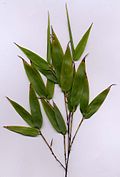 Phyllostachys nigra folium
 -
 Bamboo shoot
 -
 Bamboo barrier


