Bamboo shoot: Difference between revisions
CSV import |
CSV import Tags: Removed redirect mobile edit mobile web edit |
||
| Line 1: | Line 1: | ||
{{short description|Edible shoots of bamboo species}} | |||
{{For|the Japanese dish|Menma}} | |||
[[File:Gathering_Bamboo_Shoots,_by_Suzuki_Harunobu,_1765.jpg|thumb|right|Gathering bamboo shoots, by Suzuki Harunobu, 1765]] | |||
'''Bamboo shoots''' are the edible shoots (new culms that come out of the ground) of many [[bamboo]] species, including [[Bambusa vulgaris]] and [[Phyllostachys edulis]]. They are used as vegetables in numerous Asian dishes and broths. They are sold in various processed shapes, and are available in fresh, dried, and canned versions. | |||
==Culinary Uses== | |||
Bamboo shoots are a popular ingredient in many Asian cuisines. They are known for their crisp texture and mild flavor, which can complement a variety of dishes. In [[Chinese cuisine]], bamboo shoots are often used in stir-fries, soups, and as a filling for dumplings. In [[Japanese cuisine]], they are known as ''takenoko'' and are used in dishes such as ''takenoko gohan'' (bamboo shoot rice) and ''menma'' (fermented bamboo shoots used as a topping for [[ramen]]). | |||
[[File:Boldhamii_Shoots_Sliced.PNG|thumb|left|Sliced bamboo shoots]] | |||
In [[Korean cuisine]], bamboo shoots are called ''daenamu sun'' and are often seasoned with soy sauce, garlic, and sesame oil. In [[Thai cuisine]], they are used in curries and salads. Bamboo shoots are also a staple in [[Filipino cuisine]], where they are known as ''labong'' and are used in dishes such as ''ginataang labong'' (bamboo shoots in coconut milk). | |||
==Nutritional Value== | |||
Bamboo shoots are low in calories and high in dietary fiber. They are a good source of vitamins and minerals, including vitamin B6, vitamin E, potassium, and manganese. Bamboo shoots also contain phytochemicals that have antioxidant properties, which may contribute to health benefits such as reducing inflammation and improving heart health. | |||
==Preparation== | |||
Fresh bamboo shoots must be peeled and boiled before they are safe to eat, as they contain cyanogenic glycosides, which can be toxic if consumed raw. Boiling the shoots for 20 to 30 minutes removes these compounds, making them safe for consumption. Canned bamboo shoots are pre-cooked and can be used directly in recipes. | |||
[[File:Japanese_Hosaki_Menma.jpg|thumb|right|Japanese ''hosaki menma'']] | |||
==Cultural Significance== | |||
Bamboo shoots have been a part of Asian cuisine for centuries and are often associated with spring, as they are one of the first vegetables to emerge after winter. In many cultures, the harvesting of bamboo shoots is a traditional activity, and they are celebrated in festivals and culinary events. | |||
==Varieties== | |||
There are several varieties of bamboo shoots, each with its own unique flavor and texture. Some of the most popular varieties include: | |||
* '''Moso bamboo''' (''Phyllostachys edulis''): Known for its large size and tender texture, commonly used in Chinese and Japanese dishes. | |||
* '''Sweet bamboo''' (''Bambusa oldhamii''): Known for its sweet taste, often used in Taiwanese cuisine. | |||
* '''Giant bamboo''' (''Dendrocalamus asper''): Used in Southeast Asian dishes, known for its robust flavor. | |||
[[File:Bambooshootjf3760.JPG|thumb|left|Fresh bamboo shoots]] | |||
==Related Pages== | |||
* [[Bamboo]] | |||
* [[Menma]] | |||
* [[List of edible plants]] | |||
[[File:Yam_no_mai.jpg|thumb|right|Bamboo shoots in a traditional Japanese meal]] | |||
==Gallery== | |||
<gallery> | <gallery> | ||
File:Talabaw_(cropped).jpg|Bamboo shoots in Filipino cuisine | |||
File:Bamboo_sprouts_in_basket.jpg|Bamboo sprouts in a basket | |||
File:BambooShoot.JPG|Close-up of a bamboo shoot | |||
File:Big_Bamboo_Shoot_(Joi_Ito).jpg|Large bamboo shoot | |||
File:TakenokoBambooSprouts.jpg|Takenoko bamboo sprouts | |||
File:Talabaw_(cropped).jpg| | |||
File:Bamboo_sprouts_in_basket.jpg|Bamboo sprouts in basket | |||
File:BambooShoot.JPG| | |||
File:Big_Bamboo_Shoot_(Joi_Ito).jpg| | |||
File:TakenokoBambooSprouts.jpg|Takenoko | |||
</gallery> | </gallery> | ||
[[Category:Edible plants]] | |||
[[Category:Bamboo]] | |||
[[Category:Vegetables]] | |||
Latest revision as of 21:38, 4 March 2025
Edible shoots of bamboo species
Bamboo shoots are the edible shoots (new culms that come out of the ground) of many bamboo species, including Bambusa vulgaris and Phyllostachys edulis. They are used as vegetables in numerous Asian dishes and broths. They are sold in various processed shapes, and are available in fresh, dried, and canned versions.
Culinary Uses[edit]
Bamboo shoots are a popular ingredient in many Asian cuisines. They are known for their crisp texture and mild flavor, which can complement a variety of dishes. In Chinese cuisine, bamboo shoots are often used in stir-fries, soups, and as a filling for dumplings. In Japanese cuisine, they are known as takenoko and are used in dishes such as takenoko gohan (bamboo shoot rice) and menma (fermented bamboo shoots used as a topping for ramen).
In Korean cuisine, bamboo shoots are called daenamu sun and are often seasoned with soy sauce, garlic, and sesame oil. In Thai cuisine, they are used in curries and salads. Bamboo shoots are also a staple in Filipino cuisine, where they are known as labong and are used in dishes such as ginataang labong (bamboo shoots in coconut milk).
Nutritional Value[edit]
Bamboo shoots are low in calories and high in dietary fiber. They are a good source of vitamins and minerals, including vitamin B6, vitamin E, potassium, and manganese. Bamboo shoots also contain phytochemicals that have antioxidant properties, which may contribute to health benefits such as reducing inflammation and improving heart health.
Preparation[edit]
Fresh bamboo shoots must be peeled and boiled before they are safe to eat, as they contain cyanogenic glycosides, which can be toxic if consumed raw. Boiling the shoots for 20 to 30 minutes removes these compounds, making them safe for consumption. Canned bamboo shoots are pre-cooked and can be used directly in recipes.
Cultural Significance[edit]
Bamboo shoots have been a part of Asian cuisine for centuries and are often associated with spring, as they are one of the first vegetables to emerge after winter. In many cultures, the harvesting of bamboo shoots is a traditional activity, and they are celebrated in festivals and culinary events.
Varieties[edit]
There are several varieties of bamboo shoots, each with its own unique flavor and texture. Some of the most popular varieties include:
- Moso bamboo (Phyllostachys edulis): Known for its large size and tender texture, commonly used in Chinese and Japanese dishes.
- Sweet bamboo (Bambusa oldhamii): Known for its sweet taste, often used in Taiwanese cuisine.
- Giant bamboo (Dendrocalamus asper): Used in Southeast Asian dishes, known for its robust flavor.
Related Pages[edit]
Gallery[edit]
-
 Bamboo shoots in Filipino cuisine
 -
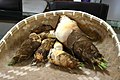 Bamboo sprouts in a basket
 -
 Close-up of a bamboo shoot
 -
 Large bamboo shoot
 -
 Takenoko bamboo sprouts
.jpg)


.jpg)


