Butea monosperma: Difference between revisions
CSV import |
CSV import |
||
| Line 1: | Line 1: | ||
{{Short description|Species of flowering plant}} | |||
{{Taxobox | |||
| name = Butea monosperma | |||
| image = STS_001_Butea_monosperma.jpg | |||
| image_caption = Butea monosperma in bloom | |||
| regnum = [[Plantae]] | |||
| unranked_divisio = [[Angiosperms]] | |||
| unranked_classis = [[Eudicots]] | |||
| unranked_ordo = [[Rosids]] | |||
| ordo = [[Fabales]] | |||
| familia = [[Fabaceae]] | |||
| genus = ''[[Butea]]'' | |||
| species = '''''B. monosperma''''' | |||
| binomial = ''Butea monosperma'' | |||
| binomial_authority = ([[Roxb.]]) [[Taub.]] | |||
}} | |||
'''''Butea monosperma''''', commonly known as the [[Flame of the Forest]], [[Bastard Teak]], or [[Palash]], is a species of [[flowering plant]] in the [[Fabaceae]] family. It is native to tropical and subtropical parts of the [[Indian subcontinent]] and [[Southeast Asia]]. | |||
== | ==Description== | ||
[[File:Butea_monosperma,_flame-of-the-forest,_bastard_teak,_ചമത._Leaf_.jpg|thumb|left|Leaves of Butea monosperma]] | |||
''Butea monosperma'' is a medium-sized [[deciduous tree]] that can grow up to 15 meters in height. The tree is known for its striking orange-red flowers, which appear in dense clusters and cover the entire tree, giving it the appearance of being on fire. The leaves are compound, with three leaflets, and are shed before the flowering season. | |||
== | ==Distribution and Habitat== | ||
''Butea monosperma'' is found in a variety of habitats, including dry forests, grasslands, and along riverbanks. It is widely distributed across [[India]], [[Bangladesh]], [[Nepal]], [[Sri Lanka]], and parts of [[Myanmar]] and [[Thailand]]. The tree is well adapted to arid conditions and can thrive in poor soil. | |||
== | ==Cultural Significance== | ||
[[File:Dhak_(Butea_monosperma)_flowers_in_Kolkata_I_IMG_4225.jpg|thumb|right|Flowers of Butea monosperma in Kolkata]] | |||
In India, ''Butea monosperma'' holds significant cultural and religious importance. It is associated with the festival of [[Holi]], where the flowers are used to make natural dyes. The tree is also considered sacred in some regions and is often planted near temples. | |||
== | ==Uses== | ||
* [[ | The tree has various uses in traditional medicine and industry. The flowers are used to produce a natural dye, while the leaves are used as fodder for livestock. The gum, known as "Butea gum" or "Bengal kino," is used in traditional medicine for its astringent properties. | ||
* [[ | |||
* [[ | ==Ecological Role== | ||
''Butea monosperma'' plays an important role in its ecosystem. The flowers attract a variety of pollinators, including bees and birds, which help in the pollination of the tree. The tree also provides habitat and food for various species of wildlife. | |||
==Gallery== | |||
<gallery> | |||
File:Butea_monosperma_Bagh-e-Jinnah.jpg|Butea monosperma in Bagh-e-Jinnah | |||
File:Bankh_prepared_from_Butea_roots.jpg|Bankh prepared from Butea roots | |||
File:Palash_Tree.jpg|Palash tree in full bloom | |||
File:Polash_flower.jpg|Close-up of Polash flower | |||
File:Butea_monosperma_plant._Yavatmal,_Maharashtra..JPG|Butea monosperma plant in Yavatmal, Maharashtra | |||
</gallery> | |||
==Related Pages== | |||
* [[Fabaceae]] | |||
* [[Flame of the Forest]] | |||
* [[Holi]] | |||
[[Category:Flora of the Indian subcontinent]] | [[Category:Flora of the Indian subcontinent]] | ||
[[Category:Flora of Southeast Asia]] | |||
[[Category:Trees of India]] | |||
[[Category:Trees of Bangladesh]] | |||
[[Category:Trees of Nepal]] | |||
[[Category:Trees of Sri Lanka]] | |||
[[Category:Trees of Myanmar]] | |||
[[Category:Trees of Thailand]] | |||
[[Category:Medicinal plants]] | [[Category:Medicinal plants]] | ||
Latest revision as of 18:48, 23 March 2025
Species of flowering plant
Butea monosperma, commonly known as the Flame of the Forest, Bastard Teak, or Palash, is a species of flowering plant in the Fabaceae family. It is native to tropical and subtropical parts of the Indian subcontinent and Southeast Asia.
Description[edit]

Butea monosperma is a medium-sized deciduous tree that can grow up to 15 meters in height. The tree is known for its striking orange-red flowers, which appear in dense clusters and cover the entire tree, giving it the appearance of being on fire. The leaves are compound, with three leaflets, and are shed before the flowering season.
Distribution and Habitat[edit]
Butea monosperma is found in a variety of habitats, including dry forests, grasslands, and along riverbanks. It is widely distributed across India, Bangladesh, Nepal, Sri Lanka, and parts of Myanmar and Thailand. The tree is well adapted to arid conditions and can thrive in poor soil.
Cultural Significance[edit]
_flowers_in_Kolkata_I_IMG_4225.jpg)
In India, Butea monosperma holds significant cultural and religious importance. It is associated with the festival of Holi, where the flowers are used to make natural dyes. The tree is also considered sacred in some regions and is often planted near temples.
Uses[edit]
The tree has various uses in traditional medicine and industry. The flowers are used to produce a natural dye, while the leaves are used as fodder for livestock. The gum, known as "Butea gum" or "Bengal kino," is used in traditional medicine for its astringent properties.
Ecological Role[edit]
Butea monosperma plays an important role in its ecosystem. The flowers attract a variety of pollinators, including bees and birds, which help in the pollination of the tree. The tree also provides habitat and food for various species of wildlife.
Gallery[edit]
-
 Butea monosperma in Bagh-e-Jinnah
 -
 Bankh prepared from Butea roots
 -
 Palash tree in full bloom
 -
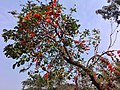 Close-up of Polash flower
 -
 Butea monosperma plant in Yavatmal, Maharashtra


