Catharanthus roseus: Difference between revisions
CSV import Tags: mobile edit mobile web edit |
CSV import |
||
| (One intermediate revision by the same user not shown) | |||
| Line 1: | Line 1: | ||
{{short description|Species of flowering plant known as Madagascar periwinkle}} | |||
{{Taxobox | |||
| name = Catharanthus roseus | |||
| image = Catharanthus_roseus_105.jpg | |||
| image_caption = Catharanthus roseus in bloom | |||
| regnum = [[Plantae]] | |||
| unranked_divisio = [[Angiosperms]] | |||
| unranked_classis = [[Eudicots]] | |||
| unranked_ordo = [[Asterids]] | |||
| ordo = [[Gentianales]] | |||
| familia = [[Apocynaceae]] | |||
| genus = ''[[Catharanthus]]'' | |||
| species = '''''C. roseus''''' | |||
| binomial = ''Catharanthus roseus'' | |||
| binomial_authority = ([[L.]]) [[G.Don]] | |||
}} | |||
'''''Catharanthus roseus''''', commonly known as the '''Madagascar periwinkle''', is a species of flowering plant in the family [[Apocynaceae]]. It is native to [[Madagascar]] but is widely cultivated and naturalized in tropical and subtropical regions worldwide. | |||
'''Catharanthus roseus''' | |||
== | ==Description== | ||
[[File:A_white_colored,_Catharanthus_Roseus_flower.jpg|thumb|left|A white colored Catharanthus roseus flower]] | |||
''Catharanthus roseus'' is an evergreen subshrub or herbaceous plant growing to 1 m (3 ft 3 in) tall. The leaves are oval to oblong, 2.5–9 cm (1–3.5 in) long and 1–3.5 cm (0.4–1.4 in) broad, glossy green, hairless, with a pale midrib and a short petiole 1–1.8 cm (0.4–0.7 in) long; they are arranged in opposite pairs. | |||
The flowers are white to dark pink with a darker red center, with a basal tube 2.5–3 cm (1–1.2 in) long and a corolla 2–5 cm (0.8–2 in) diameter with five petal-like lobes. The fruit is a pair of follicles 2–4 cm (0.8–1.6 in) long and 3 mm (0.1 in) broad. | |||
== | ==Distribution and habitat== | ||
[[File:Close-up_view_of_Catharanthus_roseus_(known_as_Nayantara_in_Bengali)_in_West_Bengal,_India,_photographed_by_Yogabrata_Chakraborty,_on_October_2,_2021.jpg|thumb|right|Close-up view of Catharanthus roseus in West Bengal, India]] | |||
''Catharanthus roseus'' is native to [[Madagascar]] but has been widely cultivated and has become naturalized in many tropical and subtropical regions, including parts of [[Asia]], [[Africa]], and the [[Americas]]. It is often found in disturbed areas, roadsides, and gardens. | |||
== | ==Cultivation== | ||
[[File:Catharanthus_in_Rajshahi,_Bangladesh.jpg|thumb|left|Catharanthus in Rajshahi, Bangladesh]] | |||
''Catharanthus roseus'' is cultivated for its attractive flowers and glossy foliage. It is a popular ornamental plant in gardens and landscapes. The plant prefers well-drained soil and a sunny position, although it can tolerate some shade. It is drought-tolerant once established but benefits from regular watering. | |||
==Uses== | |||
[[File:A_Catharanthus_Roseus_bush_in_Hyderabad,_Pakistan.jpg|thumb|right|A Catharanthus roseus bush in Hyderabad, Pakistan]] | |||
''Catharanthus roseus'' has been used in traditional medicine in various cultures. It is known for its alkaloids, which have been used in the treatment of cancer. The plant contains over 70 different alkaloids, including vincristine and vinblastine, which are used in chemotherapy. | |||
==Toxicity== | |||
The plant is toxic if ingested, and care should be taken to avoid consumption by humans and animals. The sap can also cause skin irritation in some individuals. | |||
==Gallery== | |||
<gallery> | |||
File:বৃষ্টিকণায়_নয়নতারা.jpg|Catharanthus roseus with raindrops | |||
File:Catharanthus_roseus_82.jpg|Catharanthus roseus in bloom | |||
File:_Madagascar_periwinkle_bdl8.jpg|Madagascar periwinkle | |||
</gallery> | |||
==Related pages== | |||
* [[Apocynaceae]] | |||
* [[Vincristine]] | |||
* [[Vinblastine]] | |||
[[Category:Apocynaceae]] | |||
[[Category:Flora of Madagascar]] | [[Category:Flora of Madagascar]] | ||
[[Category:Garden plants]] | |||
[[Category:Medicinal plants]] | [[Category:Medicinal plants]] | ||
Latest revision as of 14:11, 21 February 2025
Species of flowering plant known as Madagascar periwinkle
Catharanthus roseus, commonly known as the Madagascar periwinkle, is a species of flowering plant in the family Apocynaceae. It is native to Madagascar but is widely cultivated and naturalized in tropical and subtropical regions worldwide.
Description[edit]

Catharanthus roseus is an evergreen subshrub or herbaceous plant growing to 1 m (3 ft 3 in) tall. The leaves are oval to oblong, 2.5–9 cm (1–3.5 in) long and 1–3.5 cm (0.4–1.4 in) broad, glossy green, hairless, with a pale midrib and a short petiole 1–1.8 cm (0.4–0.7 in) long; they are arranged in opposite pairs.
The flowers are white to dark pink with a darker red center, with a basal tube 2.5–3 cm (1–1.2 in) long and a corolla 2–5 cm (0.8–2 in) diameter with five petal-like lobes. The fruit is a pair of follicles 2–4 cm (0.8–1.6 in) long and 3 mm (0.1 in) broad.
Distribution and habitat[edit]
_in_West_Bengal,_India,_photographed_by_Yogabrata_Chakraborty,_on_October_2,_2021.jpg)
Catharanthus roseus is native to Madagascar but has been widely cultivated and has become naturalized in many tropical and subtropical regions, including parts of Asia, Africa, and the Americas. It is often found in disturbed areas, roadsides, and gardens.
Cultivation[edit]
Catharanthus roseus is cultivated for its attractive flowers and glossy foliage. It is a popular ornamental plant in gardens and landscapes. The plant prefers well-drained soil and a sunny position, although it can tolerate some shade. It is drought-tolerant once established but benefits from regular watering.
Uses[edit]
Catharanthus roseus has been used in traditional medicine in various cultures. It is known for its alkaloids, which have been used in the treatment of cancer. The plant contains over 70 different alkaloids, including vincristine and vinblastine, which are used in chemotherapy.
Toxicity[edit]
The plant is toxic if ingested, and care should be taken to avoid consumption by humans and animals. The sap can also cause skin irritation in some individuals.
Gallery[edit]
-
 Catharanthus roseus with raindrops
 -
 Catharanthus roseus in bloom
 -
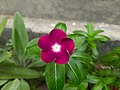 Madagascar periwinkle


