Nyamiviridae: Difference between revisions
CSV import |
CSV import |
||
| (2 intermediate revisions by the same user not shown) | |||
| Line 1: | Line 1: | ||
{{Short description|A family of negative-sense single-stranded RNA viruses}} | |||
{{Taxobox | {{Taxobox | ||
| name = Nyamiviridae | | name = Nyamiviridae | ||
| virus_group = V | | virus_group = V | ||
| ordo = Mononegavirales | | ordo = [[Mononegavirales]] | ||
| familia = Nyamiviridae | | familia = '''Nyamiviridae''' | ||
}} | }} | ||
'''Nyamiviridae''' is a family of [[negative-sense single-stranded RNA viruses]] within the order [[Mononegavirales]]. This family includes viruses that primarily infect [[arthropods]] and [[vertebrates]], including humans. | '''Nyamiviridae''' is a family of [[negative-sense single-stranded RNA viruses]] within the order [[Mononegavirales]]. This family includes viruses that primarily infect [[arthropods]] and [[vertebrates]], including humans. Members of this family are known for their potential to cause disease in humans and animals, although many remain poorly characterized. | ||
== | ==Virology== | ||
The family | The Nyamiviridae family is characterized by its [[negative-sense RNA]] genome, which is typically non-segmented. The genome encodes several structural and non-structural proteins essential for the virus's replication and assembly. The virions are generally enveloped, with a helical nucleocapsid structure. | ||
===Genome=== | |||
The genome of Nyamiviridae viruses is composed of a single strand of RNA that is approximately 10,000 to 15,000 nucleotides in length. The genome encodes for multiple proteins, including the [[nucleoprotein]] (N), [[phosphoprotein]] (P), [[matrix protein]] (M), [[glycoprotein]] (G), and the [[RNA-dependent RNA polymerase]] (L). | |||
== | ===Replication Cycle=== | ||
Nyamiviridae viruses | The replication cycle of Nyamiviridae viruses begins with the attachment of the virus to the host cell surface via the glycoprotein. Following entry into the host cell, the viral RNA is released into the cytoplasm, where it serves as a template for transcription and replication. The RNA-dependent RNA polymerase synthesizes complementary RNA strands, which are then used to produce viral proteins and new genomic RNA. Assembly of new virions occurs in the cytoplasm, followed by budding from the host cell membrane. | ||
== | ==Pathogenesis== | ||
Nyamiviridae viruses can cause a range of diseases in their hosts, from mild febrile illnesses to severe hemorrhagic fevers. The pathogenesis of these viruses is often linked to their ability to evade the host immune response and cause cell damage. | |||
== | ===Human Infections=== | ||
Nyamiviridae | Some members of the Nyamiviridae family are known to infect humans, leading to diseases that can range from mild to severe. Symptoms may include fever, headache, muscle pain, and in severe cases, hemorrhagic manifestations. | ||
===Animal Infections=== | |||
In animals, Nyamiviridae viruses can cause diseases that impact livestock and wildlife. These infections can lead to economic losses in agriculture and affect biodiversity. | |||
==Epidemiology== | ==Epidemiology== | ||
The distribution of Nyamiviridae viruses is | The distribution of Nyamiviridae viruses is global, with different species adapted to specific ecological niches. Transmission can occur through direct contact with infected hosts or via [[arthropod vectors]] such as [[mosquitoes]] and [[ticks]]. | ||
== | ==Prevention and Control== | ||
Efforts to prevent and control infections caused by Nyamiviridae viruses include vector control measures, surveillance of animal populations, and the development of vaccines and antiviral therapies. Public health strategies focus on reducing human exposure to vectors and infected animals. | |||
== | ==Research== | ||
Ongoing research aims to better understand the molecular biology, ecology, and evolution of Nyamiviridae viruses. Advances in [[genomics]] and [[bioinformatics]] are providing insights into the diversity and pathogenic potential of these viruses. | |||
==Related pages== | |||
* [[Mononegavirales]] | * [[Mononegavirales]] | ||
* [[Negative-sense single-stranded RNA virus]] | * [[Negative-sense single-stranded RNA virus]] | ||
* [[ | * [[Viral replication]] | ||
* [[ | * [[Viral pathogenesis]] | ||
[[Category:Virus families]] | [[Category:Virus families]] | ||
[[Category:Negative-sense single-stranded RNA viruses]] | [[Category:Negative-sense single-stranded RNA viruses]] | ||
== Nyamiviridae gallery == | |||
<gallery> | <gallery> | ||
File:Viruses-11-00927-g001.E.png| | File:Viruses-11-00927-g001.E.png|Viruses-11-00927-g001.E | ||
File:Viruses-11-00927-g002.A.png| | File:Viruses-11-00927-g002.A.png|Viruses-11-00927-g002.A | ||
File:ONSR.Nyami.Fig2.v8.png| | File:ONSR.Nyami.Fig2.v8.png|ONSR.Nyami.Fig2.v8 | ||
File:ONSR.Nyami.Fig3.v4.png| | File:ONSR.Nyami.Fig3.v4.png|ONSR.Nyami.Fig3.v4 | ||
</gallery> | </gallery> | ||
Latest revision as of 05:18, 3 March 2025
A family of negative-sense single-stranded RNA viruses
Nyamiviridae is a family of negative-sense single-stranded RNA viruses within the order Mononegavirales. This family includes viruses that primarily infect arthropods and vertebrates, including humans. Members of this family are known for their potential to cause disease in humans and animals, although many remain poorly characterized.
Virology[edit]
The Nyamiviridae family is characterized by its negative-sense RNA genome, which is typically non-segmented. The genome encodes several structural and non-structural proteins essential for the virus's replication and assembly. The virions are generally enveloped, with a helical nucleocapsid structure.
Genome[edit]
The genome of Nyamiviridae viruses is composed of a single strand of RNA that is approximately 10,000 to 15,000 nucleotides in length. The genome encodes for multiple proteins, including the nucleoprotein (N), phosphoprotein (P), matrix protein (M), glycoprotein (G), and the RNA-dependent RNA polymerase (L).
Replication Cycle[edit]
The replication cycle of Nyamiviridae viruses begins with the attachment of the virus to the host cell surface via the glycoprotein. Following entry into the host cell, the viral RNA is released into the cytoplasm, where it serves as a template for transcription and replication. The RNA-dependent RNA polymerase synthesizes complementary RNA strands, which are then used to produce viral proteins and new genomic RNA. Assembly of new virions occurs in the cytoplasm, followed by budding from the host cell membrane.
Pathogenesis[edit]
Nyamiviridae viruses can cause a range of diseases in their hosts, from mild febrile illnesses to severe hemorrhagic fevers. The pathogenesis of these viruses is often linked to their ability to evade the host immune response and cause cell damage.
Human Infections[edit]
Some members of the Nyamiviridae family are known to infect humans, leading to diseases that can range from mild to severe. Symptoms may include fever, headache, muscle pain, and in severe cases, hemorrhagic manifestations.
Animal Infections[edit]
In animals, Nyamiviridae viruses can cause diseases that impact livestock and wildlife. These infections can lead to economic losses in agriculture and affect biodiversity.
Epidemiology[edit]
The distribution of Nyamiviridae viruses is global, with different species adapted to specific ecological niches. Transmission can occur through direct contact with infected hosts or via arthropod vectors such as mosquitoes and ticks.
Prevention and Control[edit]
Efforts to prevent and control infections caused by Nyamiviridae viruses include vector control measures, surveillance of animal populations, and the development of vaccines and antiviral therapies. Public health strategies focus on reducing human exposure to vectors and infected animals.
Research[edit]
Ongoing research aims to better understand the molecular biology, ecology, and evolution of Nyamiviridae viruses. Advances in genomics and bioinformatics are providing insights into the diversity and pathogenic potential of these viruses.
Related pages[edit]
Nyamiviridae gallery[edit]
-
 Viruses-11-00927-g001.E
 -
 Viruses-11-00927-g002.A
 -
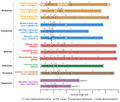 ONSR.Nyami.Fig2.v8
 -
 ONSR.Nyami.Fig3.v4


