Allosteric regulation: Difference between revisions
CSV import |
CSV import |
||
| Line 4: | Line 4: | ||
File:Allosteric_Regulation.svg|Allosteric Regulation | File:Allosteric_Regulation.svg|Allosteric Regulation | ||
</gallery> | </gallery> | ||
== Allosteric Regulation == | |||
'''Allosteric regulation''' is a fundamental mechanism by which the activity of an [[enzyme]] or other [[protein]] is modulated by the binding of an [[effector molecule]] at a specific site, distinct from the active site. This process is crucial for the regulation of metabolic pathways and cellular processes. | |||
=== Mechanism === | |||
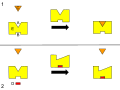
Allosteric regulation involves the binding of an effector molecule to an allosteric site, which is a site other than the active site on the enzyme. This binding induces a conformational change in the enzyme's structure, which can either enhance or inhibit its activity. The effector molecules can be either activators or inhibitors. | |||
==== Allosteric Activators ==== | |||
Allosteric activators bind to the allosteric site and stabilize the active form of the enzyme, increasing its activity. This can lead to an increase in the rate of the reaction catalyzed by the enzyme. | |||
==== Allosteric Inhibitors ==== | |||
Allosteric inhibitors bind to the allosteric site and stabilize the inactive form of the enzyme, decreasing its activity. This results in a reduction in the rate of the reaction. | |||
=== Types of Allosteric Regulation === | |||
==== Homotropic Allosteric Regulation ==== | |||
In homotropic allosteric regulation, the effector molecule is the same as the substrate of the enzyme. This often results in cooperative binding, where the binding of one substrate molecule enhances the binding of additional substrate molecules. | |||
==== Heterotropic Allosteric Regulation ==== | |||
In heterotropic allosteric regulation, the effector molecule is different from the substrate. This type of regulation allows for fine-tuning of enzyme activity in response to various cellular signals. | |||
=== Examples === | |||
==== Aspartate Transcarbamoylase (ATCase) ==== | |||
ATCase is an enzyme that catalyzes the first step in the synthesis of pyrimidines. It is regulated by allosteric inhibitors such as CTP and allosteric activators such as ATP, allowing the cell to balance the synthesis of nucleotides. | |||
==== Phosphofructokinase-1 (PFK-1) ==== | |||
PFK-1 is a key regulatory enzyme in the glycolytic pathway. It is allosterically inhibited by ATP and citrate, and activated by AMP and fructose 2,6-bisphosphate, thus playing a crucial role in the regulation of glycolysis. | |||
=== Importance in Metabolism === | |||
Allosteric regulation is essential for maintaining homeostasis within the cell. It allows for the rapid and reversible modulation of enzyme activity in response to changes in the cellular environment, such as fluctuations in metabolite concentrations or energy status. | |||
== Related Pages == | |||
* [[Enzyme kinetics]] | |||
* [[Metabolic pathway]] | |||
* [[Feedback inhibition]] | |||
* [[Cooperative binding]] | |||
{{Enzymes}} | |||
{{Molecular biology}} | |||
[[Category:Enzymes]] | |||
[[Category:Biochemistry]] | |||
[[Category:Molecular biology]] | |||
Latest revision as of 00:34, 19 February 2025
Allosteric_regulation[edit]
-
 Enzyme Model
 -
 Allosteric Regulation


Allosteric Regulation[edit]
Allosteric regulation is a fundamental mechanism by which the activity of an enzyme or other protein is modulated by the binding of an effector molecule at a specific site, distinct from the active site. This process is crucial for the regulation of metabolic pathways and cellular processes.
Mechanism[edit]
Allosteric regulation involves the binding of an effector molecule to an allosteric site, which is a site other than the active site on the enzyme. This binding induces a conformational change in the enzyme's structure, which can either enhance or inhibit its activity. The effector molecules can be either activators or inhibitors.
Allosteric Activators[edit]
Allosteric activators bind to the allosteric site and stabilize the active form of the enzyme, increasing its activity. This can lead to an increase in the rate of the reaction catalyzed by the enzyme.
Allosteric Inhibitors[edit]
Allosteric inhibitors bind to the allosteric site and stabilize the inactive form of the enzyme, decreasing its activity. This results in a reduction in the rate of the reaction.
Types of Allosteric Regulation[edit]
Homotropic Allosteric Regulation[edit]
In homotropic allosteric regulation, the effector molecule is the same as the substrate of the enzyme. This often results in cooperative binding, where the binding of one substrate molecule enhances the binding of additional substrate molecules.
Heterotropic Allosteric Regulation[edit]
In heterotropic allosteric regulation, the effector molecule is different from the substrate. This type of regulation allows for fine-tuning of enzyme activity in response to various cellular signals.
Examples[edit]
Aspartate Transcarbamoylase (ATCase)[edit]
ATCase is an enzyme that catalyzes the first step in the synthesis of pyrimidines. It is regulated by allosteric inhibitors such as CTP and allosteric activators such as ATP, allowing the cell to balance the synthesis of nucleotides.
Phosphofructokinase-1 (PFK-1)[edit]
PFK-1 is a key regulatory enzyme in the glycolytic pathway. It is allosterically inhibited by ATP and citrate, and activated by AMP and fructose 2,6-bisphosphate, thus playing a crucial role in the regulation of glycolysis.
Importance in Metabolism[edit]
Allosteric regulation is essential for maintaining homeostasis within the cell. It allows for the rapid and reversible modulation of enzyme activity in response to changes in the cellular environment, such as fluctuations in metabolite concentrations or energy status.
Related Pages[edit]
| Enzymes | ||||||||||
|---|---|---|---|---|---|---|---|---|---|---|
|
| Molecular biology | ||||||||||||||||||||
|---|---|---|---|---|---|---|---|---|---|---|---|---|---|---|---|---|---|---|---|---|
|
