Esotropia: Difference between revisions
CSV import |
CSV import |
||
| Line 1: | Line 1: | ||
'''Esotropia''' is a form of [[strabismus]] ([[Convergent strabismus]]), or eye misalignment, where one or both eyes turn inward. This condition can occur intermittently or constantly and may be present from birth or acquired later in life. Esotropia can lead to a variety of symptoms, including double vision, decreased depth perception, and vision loss in one eye (also known as [[Amblyopia|amblyopia]]) if not treated promptly | {{SI}} | ||
{{Infobox medical condition | |||
| name = Esotropia | |||
| image = [[File:Andre_Filipe_Teixeira_Marques_Esotropia.jpg|left|thumb|Esotropia in a child]] | |||
| caption = Esotropia in a child | |||
| field = [[Ophthalmology]] | |||
| synonyms = Convergent strabismus, crossed eyes | |||
| symptoms = [[Double vision]], [[eye strain]], [[headache]], [[amblyopia]] | |||
| complications = [[Amblyopia]], [[diplopia]] | |||
| onset = Usually in [[childhood]] | |||
| duration = Can be [[intermittent]] or [[constant]] | |||
| types = [[Congenital esotropia]], [[accommodative esotropia]], [[non-accommodative esotropia]] | |||
| causes = [[Genetic factors]], [[neurological disorders]], [[refractive error]] | |||
| risks = [[Family history]], [[premature birth]], [[cerebral palsy]] | |||
| diagnosis = [[Eye examination]], [[cover test]], [[prism test]] | |||
| differential = [[Exotropia]], [[hypertropia]], [[hypotropia]] | |||
| treatment = [[Corrective lenses]], [[prism glasses]], [[vision therapy]], [[strabismus surgery]] | |||
| prognosis = Good with early treatment | |||
| frequency = Common in children | |||
}} | |||
'''Esotropia''' is a form of [[strabismus]] ([[Convergent strabismus]]), or eye misalignment, where one or both eyes turn inward. This condition can occur intermittently or constantly and may be present from birth or acquired later in life. Esotropia can lead to a variety of symptoms, including double vision, decreased depth perception, and vision loss in one eye (also known as [[Amblyopia|amblyopia]]) if not treated promptly. | |||
== Classification and Symptoms == | == Classification and Symptoms == | ||
Esotropia can be broadly categorized into congenital (or infantile) esotropia, accommodative esotropia, and acquired non-accommodative esotropia. The primary symptom is an inward deviation of one or both eyes. Additional symptoms can include squinting, eye fatigue, sensitivity to light, and difficulty with depth perception. | |||
Esotropia can be broadly categorized into congenital (or infantile) esotropia, accommodative esotropia, and acquired non-accommodative esotropia. The primary symptom is an inward deviation of one or both eyes. Additional symptoms can include squinting, eye fatigue, sensitivity to light, and difficulty with depth perception | |||
== Etiology and Risk Factors == | == Etiology and Risk Factors == | ||
While the exact cause of esotropia is often unknown, it is likely a result of a combination of genetic and environmental factors. Some individuals may have a family history of the condition. Additionally, it can also be associated with certain systemic or neurological conditions such as [[Cerebral palsy|cerebral palsy]], [[Down syndrome]], [[Hydrocephalus|hydrocephalus]], or [[Premature birth|prematurity]]<ref>{{Cite journal |last1= |first1= |title=Esotropia: risk factors and etiology |journal= |volume= |issue= |pages= |year= |doi= |pmid= }}</ref>. | While the exact cause of esotropia is often unknown, it is likely a result of a combination of genetic and environmental factors. Some individuals may have a family history of the condition. Additionally, it can also be associated with certain systemic or neurological conditions such as [[Cerebral palsy|cerebral palsy]], [[Down syndrome]], [[Hydrocephalus|hydrocephalus]], or [[Premature birth|prematurity]]<ref>{{Cite journal |last1= |first1= |title=Esotropia: risk factors and etiology |journal= |volume= |issue= |pages= |year= |doi= |pmid= }}</ref>. | ||
== Diagnosis == | == Diagnosis == | ||
Diagnosis of esotropia is made through a comprehensive eye examination, which may include testing of eye alignment and movement, refraction to determine the appropriate lens power, and a detailed examination of the internal and external eye structures. Other neurological or systemic evaluations may be required if an underlying condition is suspected. | |||
Diagnosis of esotropia is made through a comprehensive eye examination, which may include testing of eye alignment and movement, refraction to determine the appropriate lens power, and a detailed examination of the internal and external eye structures. Other neurological or systemic evaluations may be required if an underlying condition is suspected | |||
== Treatment == | == Treatment == | ||
The goal of treatment is to improve eye alignment, which can enhance binocular vision, prevent amblyopia, and improve cosmetic appearance. Treatment options can range from corrective glasses in the case of accommodative esotropia, to [[Eye patching|patching]] of the stronger eye, eye exercises, or surgery. In certain cases, [[Botulinum toxin]] injections may be used as an alternative to surgery. | |||
The goal of treatment is to improve eye alignment, which can enhance binocular vision, prevent amblyopia, and improve cosmetic appearance. Treatment options can range from corrective glasses in the case of accommodative esotropia, to [[Eye patching|patching]] of the stronger eye, eye exercises, or surgery. In certain cases, [[Botulinum toxin]] injections may be used as an alternative to surgery< | == Esotropia images == | ||
<gallery> | |||
File:Esotropia-uncorrected.jpg|Uncorrected esotropia | |||
File:Esotropia-corrected.jpg|Corrected esotropia | |||
</gallery> | |||
==References== | ==References== | ||
{{Reflist}} | {{Reflist}} | ||
[[Category:Eye disorders]] | [[Category:Eye disorders]] | ||
[[Category:Strabismus]] | [[Category:Strabismus]] | ||
| Line 26: | Line 40: | ||
[[Category:Health]] | [[Category:Health]] | ||
{{stub}} | {{stub}} | ||
Latest revision as of 15:13, 6 April 2025

Editor-In-Chief: Prab R Tumpati, MD
Obesity, Sleep & Internal medicine
Founder, WikiMD Wellnesspedia &
W8MD's medical weight loss NYC, sleep center NYC
Philadelphia medical weight loss and Philadelphia sleep clinics
| Esotropia | |
|---|---|
 | |
| Synonyms | Convergent strabismus, crossed eyes |
| Pronounce | N/A |
| Specialty | N/A |
| Symptoms | Double vision, eye strain, headache, amblyopia |
| Complications | Amblyopia, diplopia |
| Onset | Usually in childhood |
| Duration | Can be intermittent or constant |
| Types | Congenital esotropia, accommodative esotropia, non-accommodative esotropia |
| Causes | Genetic factors, neurological disorders, refractive error |
| Risks | Family history, premature birth, cerebral palsy |
| Diagnosis | Eye examination, cover test, prism test |
| Differential diagnosis | Exotropia, hypertropia, hypotropia |
| Prevention | N/A |
| Treatment | Corrective lenses, prism glasses, vision therapy, strabismus surgery |
| Medication | N/A |
| Prognosis | Good with early treatment |
| Frequency | Common in children |
| Deaths | N/A |
Esotropia is a form of strabismus (Convergent strabismus), or eye misalignment, where one or both eyes turn inward. This condition can occur intermittently or constantly and may be present from birth or acquired later in life. Esotropia can lead to a variety of symptoms, including double vision, decreased depth perception, and vision loss in one eye (also known as amblyopia) if not treated promptly.
Classification and Symptoms[edit]
Esotropia can be broadly categorized into congenital (or infantile) esotropia, accommodative esotropia, and acquired non-accommodative esotropia. The primary symptom is an inward deviation of one or both eyes. Additional symptoms can include squinting, eye fatigue, sensitivity to light, and difficulty with depth perception.
Etiology and Risk Factors[edit]
While the exact cause of esotropia is often unknown, it is likely a result of a combination of genetic and environmental factors. Some individuals may have a family history of the condition. Additionally, it can also be associated with certain systemic or neurological conditions such as cerebral palsy, Down syndrome, hydrocephalus, or prematurity<ref>,
 Esotropia: risk factors and etiology,
 ,</ref>.
Diagnosis[edit]
Diagnosis of esotropia is made through a comprehensive eye examination, which may include testing of eye alignment and movement, refraction to determine the appropriate lens power, and a detailed examination of the internal and external eye structures. Other neurological or systemic evaluations may be required if an underlying condition is suspected.
Treatment[edit]
The goal of treatment is to improve eye alignment, which can enhance binocular vision, prevent amblyopia, and improve cosmetic appearance. Treatment options can range from corrective glasses in the case of accommodative esotropia, to patching of the stronger eye, eye exercises, or surgery. In certain cases, Botulinum toxin injections may be used as an alternative to surgery.
Esotropia images[edit]
-
 Uncorrected esotropia
 -
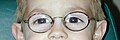 Corrected esotropia


