Osechi: Difference between revisions
CSV import |
CSV import |
||
| Line 40: | Line 40: | ||
File:Oseti.jpg | File:Oseti.jpg | ||
File:Osechi_001.jpg | File:Osechi_001.jpg | ||
</gallery> | |||
== Osechi == | |||
<gallery> | |||
File:Japanese_Osechi.jpg|Japanese Osechi | |||
File:Japanese_Osechi.png|Japanese Osechi | |||
File:Oseti.jpg|Oseti | |||
File:Osechi_001.jpg|Osechi 001 | |||
</gallery> | </gallery> | ||
Latest revision as of 11:19, 25 February 2025
Osechi are traditional Japanese New Year foods. The tradition started in the Heian Period (794-1185). Osechi are easily recognizable by their special boxes called jubako, which resemble bento boxes. Each dish and ingredient in Osechi has meanings, such as good health, fertility, good harvest, happiness, and longevity.
History[edit]
The tradition of Osechi has its roots in the Heian Period, where it was taboo to use a hearth and cook meals during the first three days of the New Year. Therefore, Osechi was made by the end of the previous year. Over time, the variety of foods prepared for Osechi has increased and it has become a significant event to welcome the New Year.
Components[edit]
Osechi consists of various dishes. Some of the common dishes and their meanings are:
- Kazunoko (herring roe): Symbolizes fertility as herring roe contains many eggs.
- Kuro-mame (black soybeans): Symbolizes health to work hard.
- Tazukuri (candied sardines): Symbolizes a good harvest.
- Kamaboko (fish cake): Alternating slices of pink and white symbolize Japan's rising sun.
- Konbu (seaweed): Symbolizes joy.
Preparation[edit]
Preparing Osechi can be time-consuming. Each dish is often prepared separately and then arranged in the jubako. Many people today buy Osechi from stores due to the complexity of preparation.
Consumption[edit]
Osechi is typically consumed in the first three days of the New Year. It is eaten communally and it is common to invite guests to share in the feast.
See also[edit]
| Japanese cuisine 日本料理 |
|---|
|
|
| New Year Celebrations | ||||||||
|---|---|---|---|---|---|---|---|---|
This New Year celebrations related article is a stub.
|
| Heian period | ||||||||||
|---|---|---|---|---|---|---|---|---|---|---|
This Heian period related article is a stub.
|

Osechi[edit]


Osechi[edit]
-
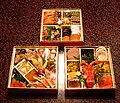 Japanese Osechi
 -
 Japanese Osechi
 -
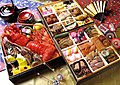 Oseti
Oseti -
 Osechi 001


