Brodmann area 30: Difference between revisions
CSV import |
No edit summary |
||
| (One intermediate revision by the same user not shown) | |||
| Line 28: | Line 28: | ||
{{Neuroscience-stub}} | {{Neuroscience-stub}} | ||
<gallery> | |||
File:Brodmann_Cytoarchitectonics_30.png|Brodmann area 30 | |||
File:Medial_parietal_lobe_close_up.png|Medial parietal lobe close up | |||
</gallery> | |||
Latest revision as of 19:12, 16 March 2025
Brodmann area 30 (BA30) is a region of the cerebral cortex in the human brain. This area is part of the posterior cingulate cortex, situated in the parietal lobe. It was defined and numbered by Korbinian Brodmann, a German neurologist, in the early 20th century based on its cytoarchitectonic characteristics, which are the organization and structure of its cells.
Location and Structure[edit]
Brodmann area 30 is located in the cingulate cortex, specifically in the posterior part of this region. The cingulate cortex is part of the limbic system, which is involved in emotion formation and processing, learning, and memory. BA30 is bordered by other Brodmann areas, including Brodmann area 23 and Brodmann area 31, which also form parts of the posterior cingulate cortex.
Function[edit]
The precise function of Brodmann area 30 is still under investigation, but it is believed to play a role in various cognitive and emotional processes due to its location in the limbic system and connections with other brain regions. It has been implicated in visuospatial processing, episodic memory retrieval, and the processing of emotionally relevant information. Additionally, BA30 is thought to contribute to the default mode network (DMN), a network of brain regions that shows higher activity when the mind is at rest and not focused on the outside world.
Clinical Significance[edit]
Alterations in the structure and function of Brodmann area 30 have been associated with several neurological and psychiatric conditions. For example, changes in BA30 have been observed in individuals with Alzheimer's disease, depression, and schizophrenia. These alterations may relate to the symptoms of these conditions, such as memory deficits, mood disturbances, and altered perception or thought processes.
Research[edit]
Ongoing research aims to further elucidate the specific roles of Brodmann area 30 in cognition and emotion, as well as its involvement in neurological and psychiatric disorders. Advanced imaging techniques, such as functional magnetic resonance imaging (fMRI) and positron emission tomography (PET), are commonly used to study BA30 and its connections with other brain regions.
See Also[edit]
References[edit]
<references/>

This article is a neuroscience stub. You can help WikiMD by expanding it!
-
 Brodmann area 30
 -
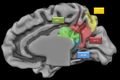 Medial parietal lobe close up


