Camera: Difference between revisions
From WikiMD's Wellness Encyclopedia
CSV import |
CSV import |
||
| Line 55: | Line 55: | ||
[[Category:Photography]] | [[Category:Photography]] | ||
[[Category:Medical imaging]] | [[Category:Medical imaging]] | ||
<gallery> | |||
File:LEI0440 Leica IIIf chrom - Sn. 580566 1951-52-M39 Blitzsynchron front view-6531 hf-.jpg|Leica IIIf chrom | |||
File:Hasselblad 500 CM.jpg|Hasselblad 500 CM | |||
File:Reflex camera simple labels.svg|Reflex camera simple labels | |||
File:Lenses with different apertures.jpg|Lenses with different apertures | |||
File:Daisies-Focus.jpg|Daisies Focus | |||
File:Focal-plane shutter.jpg|Focal-plane shutter | |||
File:Sekonic L-358 Flash Master.jpg|Sekonic L-358 Flash Master | |||
File:Nikon D200 front (aka).jpg|Nikon D200 front | |||
File:Studijskifotoaparat.JPG|Studijski fotoaparat | |||
File:Hasselblad 503.JPG|Hasselblad 503 | |||
</gallery> | |||
Latest revision as of 05:11, 3 March 2025
Camera
This medical device related article is a stub.
A camera is an optical instrument used to capture images or videos. The term "camera" comes from the Latin "camera obscura," meaning "dark chamber," an early mechanism for projecting images.
History[edit]
The development of the camera can be traced back to the ancient Greeks and Chinese, who used the camera obscura principle. The first permanent photograph was created in 1826 by Joseph Nicéphore Niépce.
Types of Cameras[edit]
Cameras can be classified into several types based on their functionality and design:
- Digital camera: Uses electronic sensors to capture images, which are stored digitally.
- Film camera: Captures images on photographic film.
- DSLR: Digital Single-Lens Reflex cameras, known for their versatility and image quality.
- Mirrorless camera: Similar to DSLRs but without a mirror mechanism, allowing for a more compact design.
- Smartphone camera: Integrated into mobile phones, widely used due to convenience and connectivity.
Components[edit]
A typical camera consists of several key components:
- Lens: Focuses light onto the image sensor or film.
- Shutter: Controls the duration of light exposure.
- Aperture: Regulates the amount of light entering the camera.
- Image sensor: Converts light into electronic signals (in digital cameras).
- Viewfinder: Allows the photographer to see the image that will be captured.
Applications in Medicine[edit]
Cameras play a crucial role in medical imaging and diagnostics. They are used in various medical devices and procedures, such as:
- Endoscopy: Cameras are used to visualize the interior of a body cavity or organ.
- Dermatology: High-resolution cameras capture images of skin conditions for diagnosis and monitoring.
- Surgical procedures: Cameras provide real-time images during minimally invasive surgeries.
See Also[edit]
References[edit]
- "History of Photography." Encyclopedia Britannica.
- "Camera Technology." Journal of Imaging Science.
External Links[edit]
- [Digital Photography Review](https://www.dpreview.com)
- [The History of the Camera](https://www.historyofcameras.com)
-
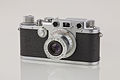 Leica IIIf chrom
 -
 Hasselblad 500 CM
 -
 Reflex camera simple labels
 -
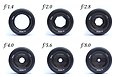 Lenses with different apertures
 -
 Daisies Focus
 -
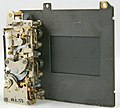 Focal-plane shutter
 -
 Sekonic L-358 Flash Master
 -
 Nikon D200 front
 -
 Studijski fotoaparat
 -
 Hasselblad 503


.jpg)


