Blind loop syndrome: Difference between revisions
From Food & Medicine Encyclopedia
CSV import |
CSV import |
||
| Line 63: | Line 63: | ||
[[Category:Digestive diseases]] | [[Category:Digestive diseases]] | ||
[[Category:Malabsorption syndromes]] | [[Category:Malabsorption syndromes]] | ||
<gallery> | |||
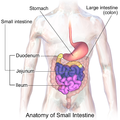
File:Blausen 0817 SmallIntestine Anatomy.png|Blind loop syndrome | |||
</gallery> | |||
Latest revision as of 00:49, 20 February 2025
| Blind loop syndrome | |
|---|---|
| Synonyms | N/A |
| Pronounce | N/A |
| Specialty | N/A |
| Symptoms | Abdominal pain, diarrhea, weight loss, malabsorption |
| Complications | Vitamin B12 deficiency, osteoporosis |
| Onset | |
| Duration | |
| Types | N/A |
| Causes | Surgical procedures, intestinal obstruction |
| Risks | |
| Diagnosis | Blood tests, imaging studies, endoscopy |
| Differential diagnosis | N/A |
| Prevention | N/A |
| Treatment | Antibiotics, surgery, dietary changes |
| Medication | N/A |
| Prognosis | |
| Frequency | |
| Deaths | N/A |
Blind loop syndrome is a condition that occurs when a part of the small intestine becomes bypassed, creating a "blind loop" where food stagnates and bacteria overgrow. This can lead to various symptoms and complications due to malabsorption of nutrients.
Causes[edit]
Blind loop syndrome can be caused by several factors, including:
- Surgical procedures that alter the normal flow of the intestine, such as gastric bypass surgery or intestinal resection.
- Intestinal obstruction due to adhesions, tumors, or strictures.
Symptoms[edit]
The symptoms of blind loop syndrome can vary but often include:
- Abdominal pain
- Diarrhea
- Weight loss
- Malabsorption of nutrients, leading to deficiencies such as Vitamin B12 deficiency
Diagnosis[edit]
Diagnosis of blind loop syndrome typically involves:
- Blood tests to check for nutritional deficiencies and signs of infection.
- Imaging studies such as CT scan or MRI to visualize the intestinal structure.
- Endoscopy to directly view the inside of the intestine and assess any abnormalities.
Treatment[edit]
Treatment options for blind loop syndrome may include:
- Antibiotics to reduce bacterial overgrowth.
- Surgery to correct the anatomical problem causing the blind loop.
- Dietary changes to manage symptoms and improve nutrient absorption.
Complications[edit]
If left untreated, blind loop syndrome can lead to complications such as:
- Vitamin B12 deficiency, which can cause anemia and neurological problems.
- Osteoporosis due to poor absorption of calcium and vitamin D.
See also[edit]
References[edit]
External links[edit]
-
 Blind loop syndrome

