Presidency of Benjamin Harrison: Difference between revisions
CSV import |
CSV import |
||
| (2 intermediate revisions by the same user not shown) | |||
| Line 1: | Line 1: | ||
The '''presidency of Benjamin Harrison''' began on March 4, 1889, when Benjamin Harrison was inaugurated as the 23rd president of the [[United States]], and ended on March 4, 1893. Harrison, a [[Republican Party (United States)|Republican]], took office after defeating incumbent [[Democratic Party (United States)|Democrat]] [[Grover Cleveland]] in the [[United States presidential election, 1888|1888 presidential election]]. | |||
| | |||
== Domestic Policy == | |||
Harrison's administration is best known for its economic legislation, including the [[McKinley Tariff]], which imposed historic protective trade rates, and the [[Sherman Antitrust Act]], the first legislation to prohibit business combinations in restraint of trade. Harrison also facilitated the creation of the [[National Forests]] through an amendment to the [[Land Revision Act of 1891]]. | |||
== | === Economic Legislation === | ||
The [[McKinley Tariff]] was passed in 1890, raising the average duty on imports to almost fifty percent, an act designed to protect domestic industries from foreign competition. The [[Sherman Antitrust Act]] was also enacted in 1890, aimed at curbing concentrations of power that interfere with trade and reduce economic competition. | |||
Harrison | === Civil Rights === | ||
Harrison advocated for [[African American]] voting rights and supported the [[Federal Elections Bill of 1890]], which sought to protect the voting rights of African Americans in the South. However, the bill was defeated in the [[Senate of the United States|Senate]]. | |||
== Foreign Policy == | == Foreign Policy == | ||
Harrison's foreign policy was characterized by vigorous promotion of [[American influence]] abroad. His administration negotiated several [[reciprocity]] treaties and sought to expand [[American trade]] and influence in [[Latin America]] and the [[Pacific]]. | |||
Harrison | === Latin America === | ||
Harrison convened the first [[Pan-American Conference]] in 1889, which led to the establishment of the [[International Union of American Republics]], a precursor to the [[Organization of American States]]. | |||
== | === Pacific Expansion === | ||
Harrison | Harrison supported the annexation of [[Hawaii]] and sent a treaty of annexation to the [[United States Senate|Senate]] in 1893, although it was not ratified until 1898 under [[William McKinley]]. | ||
== Legacy == | == Legacy == | ||
Harrison's presidency is often | Harrison's presidency is often remembered for its legislative accomplishments and its efforts to expand American influence abroad. However, his failure to secure civil rights legislation and his defeat in the [[United States presidential election, 1892|1892 election]] by [[Grover Cleveland]] overshadowed his achievements. | ||
== | == See also == | ||
* [[ | * [[List of presidents of the United States]] | ||
* [[ | * [[History of the United States (1865–1918)]] | ||
== External links == | |||
* [ | * [https://www.whitehouse.gov/about-the-white-house/presidents/benjamin-harrison/ White House biography] | ||
{{USPresidents}} | |||
[[Category:Presidency of Benjamin Harrison| ]] | |||
[[Category:Presidency of Benjamin Harrison]] | |||
[[Category:1889 in the United States]] | [[Category:1889 in the United States]] | ||
[[Category:1890s in the United States]] | [[Category:1890s in the United States]] | ||
[[Category:Republican Party (United States) politicians]] | [[Category:Republican Party (United States) politicians]] | ||
[[Category: | [[Category:History of the United States (1865–1918)]] | ||
<gallery> | |||
File:Benjamin Harrison, head and shoulders bw photo, 1896.jpg|Benjamin Harrison, head and shoulders photo, 1896 | |||
File:Harrison-Morton 1888.jpg|Harrison-Morton 1888 | |||
File:ElectoralCollege1888.svg|Electoral College 1888 | |||
File:Harrison-inauguration.jpg|Harrison inauguration | |||
File:BHarrison cabinet.jpg|Benjamin Harrison cabinet | |||
File:Benjamin Harrison (official Presidential portrait, 1895).jpg|Benjamin Harrison official Presidential portrait, 1895 | |||
File:DavidBrewer.jpg|David Brewer | |||
File:John-Sherman-2.jpg|John Sherman | |||
File:Harrison Football Political Cartoon.jpg|Harrison Football Political Cartoon | |||
File:Billion dollar Congress.jpg|Billion dollar Congress | |||
</gallery> | |||
Latest revision as of 05:17, 3 March 2025
The presidency of Benjamin Harrison began on March 4, 1889, when Benjamin Harrison was inaugurated as the 23rd president of the United States, and ended on March 4, 1893. Harrison, a Republican, took office after defeating incumbent Democrat Grover Cleveland in the 1888 presidential election.
Domestic Policy[edit]
Harrison's administration is best known for its economic legislation, including the McKinley Tariff, which imposed historic protective trade rates, and the Sherman Antitrust Act, the first legislation to prohibit business combinations in restraint of trade. Harrison also facilitated the creation of the National Forests through an amendment to the Land Revision Act of 1891.
Economic Legislation[edit]
The McKinley Tariff was passed in 1890, raising the average duty on imports to almost fifty percent, an act designed to protect domestic industries from foreign competition. The Sherman Antitrust Act was also enacted in 1890, aimed at curbing concentrations of power that interfere with trade and reduce economic competition.
Civil Rights[edit]
Harrison advocated for African American voting rights and supported the Federal Elections Bill of 1890, which sought to protect the voting rights of African Americans in the South. However, the bill was defeated in the Senate.
Foreign Policy[edit]
Harrison's foreign policy was characterized by vigorous promotion of American influence abroad. His administration negotiated several reciprocity treaties and sought to expand American trade and influence in Latin America and the Pacific.
Latin America[edit]
Harrison convened the first Pan-American Conference in 1889, which led to the establishment of the International Union of American Republics, a precursor to the Organization of American States.
Pacific Expansion[edit]
Harrison supported the annexation of Hawaii and sent a treaty of annexation to the Senate in 1893, although it was not ratified until 1898 under William McKinley.
Legacy[edit]
Harrison's presidency is often remembered for its legislative accomplishments and its efforts to expand American influence abroad. However, his failure to secure civil rights legislation and his defeat in the 1892 election by Grover Cleveland overshadowed his achievements.
See also[edit]
External links[edit]


-
 Benjamin Harrison, head and shoulders photo, 1896
 -
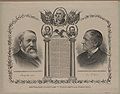 Harrison-Morton 1888
 -
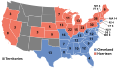 Electoral College 1888
 -
 Harrison inauguration
 -
 Benjamin Harrison cabinet
 -
 Benjamin Harrison official Presidential portrait, 1895
 -
 David Brewer
 -
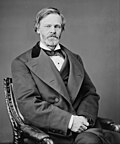 John Sherman
 -
 Harrison Football Political Cartoon
 -
 Billion dollar Congress


.jpg)


