Wakame: Difference between revisions
CSV import |
CSV import |
||
| Line 43: | Line 43: | ||
{{medicine-stub}} | {{medicine-stub}} | ||
== Wakame == | |||
<gallery> | |||
File:Korea-Miyeok-01.jpg|Wakame | |||
File:Boiled wakame.jpg|Boiled Wakame | |||
File:Miso Soup 001.jpg|Miso Soup with Wakame | |||
File:Wakame chez Mika Sushi .JPG|Wakame chez Mika Sushi | |||
File:Wakame and fish.jpg|Wakame and Fish | |||
File:So-gogi-miyeok-guk.jpg|So-gogi Miyeok-guk | |||
File:Oi-miyeok-naengguk.jpg|Oi-miyeok-naengguk | |||
File:Miyeokjulgibokkeum.jpg|Miyeok Julgi Bokkeum | |||
File:Salade d'algues Wakamé de chez Azuki (Mâcon).jpg|Salade d'algues Wakamé de chez Azuki | |||
File:Undaria pinnatifida growth stages.jpg|Undaria pinnatifida Growth Stages | |||
File:CSIRO ScienceImage 904 Undaria pinnatifida Japanese kelp.jpg|Undaria pinnatifida Japanese Kelp | |||
</gallery> | |||
Latest revision as of 01:46, 20 February 2025


Wakame is a species of edible seaweed, also known as Undaria pinnatifida. It is a type of brown algae that is commonly used in Japanese cuisine, as well as in other East Asian cuisines such as Korean and Chinese. Wakame is known for its subtly sweet flavor and silky texture.
Description[edit]
Wakame is a dark green seaweed that grows in temperate coastal areas. It has a distinctive, feathery appearance and can grow up to several meters in length. The plant consists of a holdfast, which anchors it to the seabed, a stipe, and a frond that is divided into numerous leaflets.
Culinary Uses[edit]
Wakame is often used in soups, salads, and as a garnish. In Japanese cuisine, it is a key ingredient in miso soup and is also used in seaweed salads. In Korean cuisine, it is known as miyeok and is commonly used in soups such as miyeok-guk, which is traditionally eaten on birthdays and by women after childbirth.
Nutritional Value[edit]
Wakame is rich in essential nutrients, including iodine, calcium, magnesium, and iron. It is also a good source of vitamins such as vitamin A, vitamin C, vitamin D, vitamin E, and vitamin K. Additionally, wakame contains fucoxanthin, a compound that has been studied for its potential anti-obesity effects.
Health Benefits[edit]
Wakame has been associated with various health benefits, including:
- Supporting thyroid function due to its high iodine content.
- Promoting bone health because of its calcium and magnesium content.
- Providing antioxidant properties through its vitamins and minerals.
- Potentially aiding in weight management due to the presence of fucoxanthin.
Cultivation and Harvesting[edit]
Wakame is cultivated in several countries, including Japan, Korea, and China. It is typically grown on ropes suspended in the ocean and harvested during the spring. After harvesting, wakame is often blanched and dried for preservation.
Environmental Impact[edit]
Wakame is considered an invasive species in some parts of the world, including New Zealand and parts of Europe. It can outcompete native seaweed species and disrupt local marine ecosystems.
See Also[edit]
References[edit]
<references group="" responsive="1"></references>
External Links[edit]


Wakame[edit]
-
 Wakame
 -
 Boiled Wakame
 -
 Miso Soup with Wakame
 -
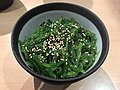 Wakame chez Mika Sushi
 -
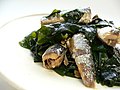 Wakame and Fish
 -
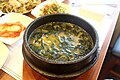 So-gogi Miyeok-guk
 -
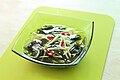 Oi-miyeok-naengguk
 -
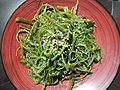 Miyeok Julgi Bokkeum
 -
 Salade d'algues Wakamé de chez Azuki
 -
 Undaria pinnatifida Growth Stages
 -
 Undaria pinnatifida Japanese Kelp


.jpg)
