Royal Marines: Difference between revisions
CSV import |
CSV import |
||
| (3 intermediate revisions by the same user not shown) | |||
| Line 1: | Line 1: | ||
The '''Royal Marines''' are the United Kingdom's [[amphibious infantry]] force and form part of the [[Naval Service]] along with the [[Royal Navy]]. They were formed in 1664 and have a long history of service in various conflicts around the world. | |||
The | == History == | ||
The Royal Marines were formed on 28 October 1664 as the "Duke of York and Albany's Maritime Regiment of Foot". They have served in numerous conflicts, including the [[Napoleonic Wars]], the [[Crimean War]], both [[World War I]] and [[World War II]], the [[Falklands War]], and more recent conflicts such as the [[Iraq War]] and the [[War in Afghanistan (2001–2021)|War in Afghanistan]]. | |||
== | == Role and Capabilities == | ||
The Royal Marines | The Royal Marines are a highly versatile force capable of deploying at short notice in support of the United Kingdom's military and diplomatic objectives. They specialize in [[amphibious warfare]], [[expeditionary warfare]], and [[littoral warfare]]. The Royal Marines are trained to operate in all environments and climates, including [[arctic warfare]], [[mountain warfare]], [[jungle warfare]], and [[desert warfare]]. | ||
== | == Organization == | ||
The | The Royal Marines are organized into several units, including the [[3 Commando Brigade]], which is the main combat formation. The brigade includes three [[Commando]] units: [[40 Commando]], [[42 Commando]], and [[45 Commando]]. Each unit is capable of deploying independently or as part of a larger force. | ||
== | == Training == | ||
Royal Marines undergo one of the longest and most demanding infantry training regimes in the world. The training takes place at the [[Commando Training Centre Royal Marines]] (CTCRM) in [[Lympstone]], [[Devon]]. The training includes physical fitness, weapons handling, survival skills, and amphibious operations. | |||
== | == Equipment == | ||
The Royal Marines are equipped with a range of weapons and vehicles suitable for their role. This includes the [[SA80]] rifle, [[L115A3]] sniper rifle, and various support weapons. They also use [[landing craft]], [[helicopters]], and other vehicles to conduct operations. | |||
== | == Notable Operations == | ||
The Royal Marines | The Royal Marines have been involved in many notable operations, including the [[D-Day landings]] during World War II, the [[Suez Crisis]], and the [[Falklands War]]. More recently, they have been deployed in [[Iraq]] and [[Afghanistan]]. | ||
== | == See also == | ||
* [[Royal Navy]] | * [[Royal Navy]] | ||
* [[British Armed Forces]] | * [[British Armed Forces]] | ||
* [[Amphibious warfare]] | |||
* [[Commando]] | * [[Commando]] | ||
== External links == | |||
== | * [https://www.royalnavy.mod.uk/our-organisation/the-fighting-arms/royal-marines Official Royal Marines website] | ||
* [ | {{Royal Navy}} | ||
{{nt}} | |||
[[Category:Royal Marines| ]] | |||
[[Category:Royal Marines | |||
[[Category:Military units and formations established in 1664]] | [[Category:Military units and formations established in 1664]] | ||
[[Category: | [[Category:Amphibious units and formations]] | ||
[[Category:British Armed Forces]] | |||
== Royal Marines gallery == | |||
<gallery> | |||
File:RoyalMarineBadge.svg|Royal Marine Badge | |||
File:Flag of the Royal Marines.svg|Flag of the Royal Marines | |||
File:Royal Marines Commando.svg|Royal Marines Commando | |||
File:Major General John Tupper.JPG|Major General John Tupper | |||
File:Private of Marines.jpg|Private of Marines | |||
File:British Marines in Chania, 1897.jpg|British Marines in Chania, 1897 | |||
File:Commandos archery.jpg|Commandos archery | |||
File:House to house fighting at Riva Bella near Ouistreham.jpg|House to house fighting at Riva Bella near Ouistreham | |||
File:Royal Marine Commandos attached to 3rd Division move inland from Sword Beach on the Normandy coast, 6 June 1944. B5071.jpg|Royal Marine Commandos attached to 3rd Division move inland from Sword Beach on the Normandy coast, 6 June 1944 | |||
File:Royal Marines on Rigid Raider.jpg|Royal Marines on Rigid Raider | |||
</gallery> | |||
Latest revision as of 05:27, 3 March 2025
The Royal Marines are the United Kingdom's amphibious infantry force and form part of the Naval Service along with the Royal Navy. They were formed in 1664 and have a long history of service in various conflicts around the world.
History[edit]
The Royal Marines were formed on 28 October 1664 as the "Duke of York and Albany's Maritime Regiment of Foot". They have served in numerous conflicts, including the Napoleonic Wars, the Crimean War, both World War I and World War II, the Falklands War, and more recent conflicts such as the Iraq War and the War in Afghanistan.
Role and Capabilities[edit]
The Royal Marines are a highly versatile force capable of deploying at short notice in support of the United Kingdom's military and diplomatic objectives. They specialize in amphibious warfare, expeditionary warfare, and littoral warfare. The Royal Marines are trained to operate in all environments and climates, including arctic warfare, mountain warfare, jungle warfare, and desert warfare.
Organization[edit]
The Royal Marines are organized into several units, including the 3 Commando Brigade, which is the main combat formation. The brigade includes three Commando units: 40 Commando, 42 Commando, and 45 Commando. Each unit is capable of deploying independently or as part of a larger force.
Training[edit]
Royal Marines undergo one of the longest and most demanding infantry training regimes in the world. The training takes place at the Commando Training Centre Royal Marines (CTCRM) in Lympstone, Devon. The training includes physical fitness, weapons handling, survival skills, and amphibious operations.
Equipment[edit]
The Royal Marines are equipped with a range of weapons and vehicles suitable for their role. This includes the SA80 rifle, L115A3 sniper rifle, and various support weapons. They also use landing craft, helicopters, and other vehicles to conduct operations.
Notable Operations[edit]
The Royal Marines have been involved in many notable operations, including the D-Day landings during World War II, the Suez Crisis, and the Falklands War. More recently, they have been deployed in Iraq and Afghanistan.
See also[edit]
External links[edit]
 |
| His Majesty's Naval Service of the British Armed Forces |
|---|
| Components |
|
| History and future |
| Operations |
| Equipment |
| Personnel |
| Auxiliary services |
Royal Marines gallery[edit]
-
 Royal Marine Badge
 -
 Flag of the Royal Marines
 -
 Royal Marines Commando
 -
Major General John Tupper
-
 Private of Marines
 -
 British Marines in Chania, 1897
 -
 Commandos archery
 -
 House to house fighting at Riva Bella near Ouistreham
 -
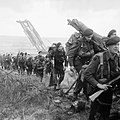 Royal Marine Commandos attached to 3rd Division move inland from Sword Beach on the Normandy coast, 6 June 1944
 -
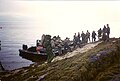 Royal Marines on Rigid Raider


