Sudan: Difference between revisions
CSV import |
CSV import |
||
| Line 24: | Line 24: | ||
[[Category:Countries in Africa]] | [[Category:Countries in Africa]] | ||
[[Category:Sudan]] | [[Category:Sudan]] | ||
<gallery> | |||
File:Sudanese national anthem, performed by the U.S. Navy Band (instrumental).oga|Sudanese national anthem | |||
File:Sudan (orthographic projection) highlighted.svg|Sudan map | |||
File:Western Deffufa - Kerma.jpg|Western Deffufa - Kerma | |||
File:Fortress of the Middle Kingdom, reconstructed under the New Kingdom ( about 1200 B.C.).jpg|Fortress of the Middle Kingdom | |||
File:Wallpaper group-pmg-4.jpg|Wallpaper group pmg 4 | |||
File:Exposition Nubia, Land of the Black Pharaohs – Mirror. Kerma Period, 1700-1550 BC.jpg|Exposition Nubia, Land of the Black Pharaohs | |||
File:Nubian Prince Hekanefer bringing tribute for King Tut, 18th dynasty, Tomb of Huy.jpg|Nubian Prince Hekanefer bringing tribute for King Tut | |||
File:Sudan Meroe Pyramids 2001.JPG|Meroe Pyramids | |||
File:Xerxes detail Ethiopian.jpg|Xerxes detail Ethiopian | |||
File:Christian Nubia.png|Christian Nubia | |||
File:King Moses George of Makuria.jpg|King Moses George of Makuria | |||
File:Sennar mosque (cropped).jpg|Sennar mosque | |||
</gallery> | |||
Latest revision as of 01:21, 20 February 2025
File:Sudanese national anthem, performed by the U.S. Navy Band.oga
_highlighted.svg)

.jpg)


Sudan, officially known as the Republic of the Sudan (Arabic: جمهورية السودان), is a country located in Northeast Africa. It is bordered by Egypt to the north, the Red Sea to the northeast, Eritrea and Ethiopia to the east, South Sudan to the south, the Central African Republic to the southwest, Chad to the west, and Libya to the northwest. Sudan has a rich history that dates back to the ancient civilizations of Nubia, and it has been a crossroads of culture, religion, and trade for centuries.
Geography[edit]
Sudan is the third-largest country in Africa and the 16th largest in the world, covering an area of over 1.8 million square kilometers. It features a variety of landscapes, from the deserts of the Sahara in the north to the mountain ranges in the far south, including the Marrah Mountains. The Nile River is the dominant geographic feature, flowing northward through the country and providing essential water resources, agriculture, and transportation routes. The country also includes several significant tributaries of the Nile, including the Blue Nile and the White Nile, which converge in the capital, Khartoum.
History[edit]
The region that is now Sudan has been inhabited since ancient times, with the Kingdom of Kush serving as a major power in northeastern Africa around 1070 BC. Throughout the centuries, Sudan has seen the rise and fall of several kingdoms and civilizations, including Christian Nubian kingdoms and Islamic sultanates. The 19th century saw the invasion by the Ottoman Empire, followed by the British-Egyptian co-dominion in 1899. Sudan gained independence from the British and Egyptians on January 1, 1956. Since independence, Sudan has experienced a mix of democratic governments and authoritarian regimes, including the long rule of Omar al-Bashir, who was ousted in 2019 following widespread protests.
Politics[edit]
Sudan is a federal provisional government. The country has been undergoing a transition to democracy, although this process has faced significant challenges, including military coups and political instability. The government structure is based on the 2005 Constitution, although its provisions have been subject to suspension and amendments, especially following the political upheavals and the secession of South Sudan in 2011, which significantly impacted Sudan's economy and territorial integrity.
Economy[edit]
Sudan's economy is diverse, with agriculture playing a significant role, employing the majority of the population and contributing a substantial part of the GDP. The country is rich in natural resources, including petroleum and minerals, although the secession of South Sudan resulted in a loss of a large portion of its oil reserves. Sudan also faces challenges such as inflation, unemployment, and the need for economic reforms to attract foreign investment and improve its economic infrastructure.
Culture[edit]
Sudanese culture is marked by its diversity, reflecting the influences of its many ethnic groups and their languages, music, dance, and traditions. Islam is the dominant religion, and Arabic and English are the official languages. Sudan is known for its literature, including poetry and novels, many of which explore themes of identity, conflict, and the rich cultural heritage of the Sudanese people.
Challenges[edit]
Sudan faces numerous challenges, including political instability, economic difficulties, and humanitarian issues. Conflicts in regions such as Darfur, the Blue Nile, and South Kordofan have resulted in significant displacement and suffering. The country also deals with issues related to human rights, freedom of the press, and the need for social and economic reforms.
Conclusion[edit]
Sudan, with its rich history and cultural diversity, stands at a crossroads, facing significant challenges but also possessing the potential for a brighter future. The ongoing transition towards democracy and efforts to address economic and social issues are critical for its stability and development.
-
 Sudanese national anthem
 -
 Sudan map
 -
 Western Deffufa - Kerma
 -
 Fortress of the Middle Kingdom
 -
 Wallpaper group pmg 4
 -
 Exposition Nubia, Land of the Black Pharaohs
 -
 Nubian Prince Hekanefer bringing tribute for King Tut
 -
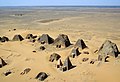 Meroe Pyramids
 -
 Xerxes detail Ethiopian
 -
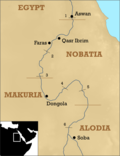 Christian Nubia
 -
 King Moses George of Makuria
 -
 Sennar mosque


.jpg)
