Vegetable oil: Difference between revisions
No edit summary |
CSV import |
||
| (One intermediate revision by the same user not shown) | |||
| Line 1: | Line 1: | ||
{{Infobox food | {{Infobox food | ||
| name = Vegetable | | name = Vegetable oil | ||
| image = | | image = <!-- Image of vegetable oil --> | ||
| caption = | | caption = Bottles of various types of vegetable oils | ||
| type = Cooking oil | | type = Cooking oil | ||
| | | main_ingredient = Plant oils | ||
}} | }} | ||
'''Vegetable oil''' is a [[triglyceride]] extracted from | '''Vegetable oil''' is a [[triglyceride]] extracted from a [[plant]]. Such oils have been part of human culture for millennia. The term "vegetable oil" can be narrowly defined as referring only to plant oils that are liquid at room temperature, or broadly defined without regard to a substance's state of matter at a given temperature. | ||
==Types of Vegetable Oils== | |||
Vegetable oils | == Types of Vegetable Oils == | ||
* [[ | Vegetable oils are derived from various parts of plants. Common types include: | ||
* [[ | |||
* [[ | * [[Olive oil]] - extracted from the fruit of the [[olive tree]]. | ||
* [[ | * [[Canola oil]] - derived from [[rapeseed]] and known for its low [[saturated fat]] content. | ||
* [[ | * [[Sunflower oil]] - obtained from the seeds of the [[sunflower]] plant. | ||
* [[ | * [[Soybean oil]] - extracted from [[soybeans]], widely used in cooking and food processing. | ||
== | * [[Coconut oil]] - derived from the [[kernel]] or meat of [[coconuts]]. | ||
* [[Palm oil]] - obtained from the fruit of the [[oil palm]] tree. | |||
==Health | |||
The health | == Uses == | ||
==Environmental | Vegetable oils are used in a variety of ways: | ||
The production of vegetable | |||
* '''Cooking''': They are commonly used for frying, baking, and as a base for salad dressings. | |||
* '''Industrial''': Used in the production of [[biodiesel]], [[cosmetics]], and [[soaps]]. | |||
==See Also== | * '''Nutritional''': Some oils, like olive oil, are considered healthy due to their high content of [[monounsaturated fats]]. | ||
* [[ | |||
* [[ | == Health Implications == | ||
* [[ | The health effects of vegetable oils can vary depending on the type of oil and how it is used. Oils high in [[polyunsaturated fats]], such as sunflower and soybean oil, are often recommended for their potential heart health benefits. However, oils high in [[trans fats]], which can be created during the hydrogenation process, are associated with negative health effects. | ||
* [[ | |||
[[ | == Production == | ||
The production of vegetable oil involves several steps: | |||
1. '''Extraction''': The oil is extracted from the plant material using mechanical pressing or chemical solvents. | |||
2. '''Refining''': The crude oil is refined to remove impurities, which may include [[free fatty acids]], [[phospholipids]], and [[pigments]]. | |||
3. '''Bleaching''': The oil is treated with bleaching agents to remove color. | |||
4. '''Deodorizing''': The oil is heated to remove volatile compounds that can affect flavor and odor. | |||
== Environmental Impact == | |||
The production of certain vegetable oils, particularly palm oil, has been linked to [[deforestation]] and [[habitat destruction]]. Sustainable practices and certifications, such as those from the [[Roundtable on Sustainable Palm Oil]] (RSPO), aim to mitigate these impacts. | |||
== See Also == | |||
* [[Cooking oil]] | |||
* [[Fat]] | |||
* [[Lipid]] | |||
* [[Saturated fat]] | |||
* [[Unsaturated fat]] | |||
== References == | |||
{{Reflist}} | |||
== External Links == | |||
* [https://www.wikimd.com/wiki/Vegetable_oil Vegetable oil on WikiMD] | |||
[[Category:Cooking oils]] | [[Category:Cooking oils]] | ||
[[Category: | [[Category:Vegetable products]] | ||
[[Category:Food ingredients]] | |||
[[Category:Plant oils]] | |||
== Vegetable oil == | |||
<gallery> | |||
File:Olive_oil_from_Oneglia.jpg|Olive oil from Oneglia | |||
File:Peanut_oil_bottle.jpg|Peanut oil bottle | |||
File:World_Production_Of_Main_Vegetable_Oils_By_Main_Producers_(2020).svg|World Production Of Main Vegetable Oils By Main Producers (2020) | |||
File:World_Food_and_Agriculture_-_Statistical_Yearbook_2023.pdf|World Food and Agriculture - Statistical Yearbook 2023 | |||
</gallery> | |||
Latest revision as of 21:07, 23 February 2025
| [[File:|frameless|alt=]] | |
| Bottles of various types of vegetable oils | |
| Alternative names | |
| Type | Cooking oil |
| Course | |
| Place of origin | |
| Region or state | |
| Associated national cuisine | |
| Created by | |
| Invented | |
| Cooking time | minutes to minutes |
| Serving temperature | |
| Main ingredients | Plant oils |
| Ingredients generally used | |
| Variations | |
| Food energy | kcal |
| Nutritional value | Protein: g, Fat: g, Carbohydrate: g |
| Glycemic index | |
| Similar dishes | |
| Other information | |
| Website | [ Official website] |
Vegetable oil is a triglyceride extracted from a plant. Such oils have been part of human culture for millennia. The term "vegetable oil" can be narrowly defined as referring only to plant oils that are liquid at room temperature, or broadly defined without regard to a substance's state of matter at a given temperature.
Types of Vegetable Oils[edit]
Vegetable oils are derived from various parts of plants. Common types include:
- Olive oil - extracted from the fruit of the olive tree.
- Canola oil - derived from rapeseed and known for its low saturated fat content.
- Sunflower oil - obtained from the seeds of the sunflower plant.
- Soybean oil - extracted from soybeans, widely used in cooking and food processing.
- Coconut oil - derived from the kernel or meat of coconuts.
- Palm oil - obtained from the fruit of the oil palm tree.
Uses[edit]
Vegetable oils are used in a variety of ways:
- Cooking: They are commonly used for frying, baking, and as a base for salad dressings.
- Industrial: Used in the production of biodiesel, cosmetics, and soaps.
- Nutritional: Some oils, like olive oil, are considered healthy due to their high content of monounsaturated fats.
Health Implications[edit]
The health effects of vegetable oils can vary depending on the type of oil and how it is used. Oils high in polyunsaturated fats, such as sunflower and soybean oil, are often recommended for their potential heart health benefits. However, oils high in trans fats, which can be created during the hydrogenation process, are associated with negative health effects.
Production[edit]
The production of vegetable oil involves several steps:
1. Extraction: The oil is extracted from the plant material using mechanical pressing or chemical solvents. 2. Refining: The crude oil is refined to remove impurities, which may include free fatty acids, phospholipids, and pigments. 3. Bleaching: The oil is treated with bleaching agents to remove color. 4. Deodorizing: The oil is heated to remove volatile compounds that can affect flavor and odor.
Environmental Impact[edit]
The production of certain vegetable oils, particularly palm oil, has been linked to deforestation and habitat destruction. Sustainable practices and certifications, such as those from the Roundtable on Sustainable Palm Oil (RSPO), aim to mitigate these impacts.
See Also[edit]
References[edit]
<references group="" responsive="1"></references>
External Links[edit]
Vegetable oil[edit]
-
 Olive oil from Oneglia
 -
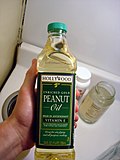 Peanut oil bottle
 -
World Production Of Main Vegetable Oils By Main Producers (2020)
-
 World Food and Agriculture - Statistical Yearbook 2023


.svg)