Concasse: Difference between revisions
CSV import Tags: mobile edit mobile web edit |
CSV import |
||
| (One intermediate revision by the same user not shown) | |||
| Line 1: | Line 1: | ||
''' | {{Short description|A culinary technique for preparing tomatoes}} | ||
[[File:Concassee de tomates.JPG|thumb|right|Concassée de tomates]] | |||
'''Concassé''' is a [[culinary]] term derived from the [[French language|French]] word "concasser," meaning "to crush" or "to grind." It refers to a specific method of preparing [[tomato|tomatoes]] by peeling, seeding, and chopping them into small pieces. This technique is commonly used in [[French cuisine]] and is a fundamental skill taught in [[culinary school|culinary schools]]. | |||
==Preparation== | ==Preparation== | ||
The | The preparation of tomato concassé involves several steps to ensure the tomatoes are properly peeled, seeded, and chopped. The process is as follows: | ||
===Blanching=== | |||
[[File:Concassee de tomates.JPG|thumb|left|Blanched tomatoes ready for peeling]] | |||
To begin, the tomatoes are blanched. This involves scoring the bottom of each tomato with a small "X" and then immersing them in boiling water for about 30 seconds. This step loosens the skin, making it easier to peel. | |||
== | ===Peeling=== | ||
After blanching, the tomatoes are immediately transferred to an [[ice bath]] to stop the cooking process. Once cooled, the skins are easily removed by hand. | |||
== | ===Seeding=== | ||
The peeled tomatoes are then cut in half, and the seeds are removed. This can be done by gently squeezing the tomato halves or using a small spoon to scoop out the seeds. | |||
== | ===Chopping=== | ||
Finally, the tomatoes are chopped into small, uniform pieces. The size of the pieces can vary depending on the recipe requirements, but they are typically diced into small cubes. | |||
==Uses== | |||
Tomato concassé is used in a variety of dishes, including [[sauces]], [[soups]], and [[stews]]. It provides a fresh tomato flavor and a desirable texture to many recipes. It is often used as a base for [[salsa]], [[bruschetta]], and [[ratatouille]]. | |||
==Related pages== | |||
* [[Tomato sauce]] | |||
* [[French cuisine]] | |||
* [[Culinary arts]] | * [[Culinary arts]] | ||
[[Category: | [[Category:Culinary techniques]] | ||
[[Category:French cuisine]] | [[Category:French cuisine]] | ||
<gallery> | |||
File:Concassee_de_tomates.JPG|Concassee de tomates | |||
</gallery> | |||
Latest revision as of 11:31, 25 February 2025
A culinary technique for preparing tomatoes

Concassé is a culinary term derived from the French word "concasser," meaning "to crush" or "to grind." It refers to a specific method of preparing tomatoes by peeling, seeding, and chopping them into small pieces. This technique is commonly used in French cuisine and is a fundamental skill taught in culinary schools.
Preparation[edit]
The preparation of tomato concassé involves several steps to ensure the tomatoes are properly peeled, seeded, and chopped. The process is as follows:
Blanching[edit]
To begin, the tomatoes are blanched. This involves scoring the bottom of each tomato with a small "X" and then immersing them in boiling water for about 30 seconds. This step loosens the skin, making it easier to peel.
Peeling[edit]
After blanching, the tomatoes are immediately transferred to an ice bath to stop the cooking process. Once cooled, the skins are easily removed by hand.
Seeding[edit]
The peeled tomatoes are then cut in half, and the seeds are removed. This can be done by gently squeezing the tomato halves or using a small spoon to scoop out the seeds.
Chopping[edit]
Finally, the tomatoes are chopped into small, uniform pieces. The size of the pieces can vary depending on the recipe requirements, but they are typically diced into small cubes.
Uses[edit]
Tomato concassé is used in a variety of dishes, including sauces, soups, and stews. It provides a fresh tomato flavor and a desirable texture to many recipes. It is often used as a base for salsa, bruschetta, and ratatouille.
Related pages[edit]
-
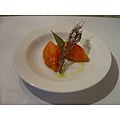 Concassee de tomates
