Diospyros nigra: Difference between revisions
CSV import |
CSV import |
||
| Line 19: | Line 19: | ||
[[Category:Diospyros]] | [[Category:Diospyros]] | ||
{{food-stub}} | {{food-stub}} | ||
<gallery> | |||
File:Diospyros_nigra_Blanco2.372-cropped.jpg|Diospyros nigra illustration | |||
File:BlackSapote_Cupidon1_Asit.jpg|Black Sapote fruit | |||
File:BlackSapote_Cupidon2_Asit.jpg|Black Sapote fruit | |||
File:BlackSapote_Cupidon3_Asit.jpg|Black Sapote fruit | |||
File:BlackSapote_Cupidon4_Asit.jpg|Black Sapote fruit | |||
File:BlackSapote_Cupidon5_Asit.jpg|Black Sapote fruit | |||
</gallery> | |||
Latest revision as of 10:59, 18 February 2025

Diospyros nigra, commonly known as the black sapote, is a species of the genus Diospyros, which also includes other economically important plants such as the persimmon. Native to eastern Mexico, the Caribbean, Central America, and into Colombia, the black sapote is a tropical fruit well-regarded for its culinary and nutritional value.
Description[edit]
The black sapote tree can grow up to 25 meters in height, with a round, spreading canopy. It is evergreen in tropical climates, with glossy, dark green leaves that are oblong to elliptical in shape. The tree produces small, bell-shaped, greenish-white flowers. The fruit of the black sapote is tomato-like in appearance, with a round shape and a diameter of 5-10 cm. When ripe, the fruit's skin turns a deep green to almost black, and the flesh becomes chocolate brown, soft, and custardy in texture. The taste is often described as sweet, with a flavor reminiscent of chocolate pudding, which has earned it the nickname "chocolate pudding fruit."
Cultivation[edit]
Diospyros nigra thrives in warm, tropical to subtropical climates and is frost-sensitive. It prefers well-drained, rich soils and can be propagated by seeds or grafting. The tree begins to bear fruit after 3-4 years when grown from seed and can produce fruit twice a year. The fruits are typically harvested by hand when they are fully mature, as indicated by a slight softening and color change of the skin.
Culinary Uses[edit]
The black sapote's unique flavor and texture make it a versatile ingredient in various culinary applications. It is often eaten fresh or used in desserts, smoothies, and baking. The fruit can also be combined with citrus juices or other fruits to enhance its flavor. In addition to its use in sweet dishes, black sapote can be incorporated into savory recipes, such as sauces and marinades.
Nutritional Value[edit]
Black sapote is rich in vitamins and minerals, particularly Vitamin C, calcium, and phosphorus. It is also a good source of dietary fiber and contains antioxidants that may offer health benefits, including supporting heart health and aiding in digestion.
Conservation and Challenges[edit]
While not currently listed as endangered, the cultivation and natural habitats of Diospyros nigra face challenges due to deforestation, climate change, and the expansion of agriculture in its native regions. Efforts to conserve and sustainably cultivate black sapote are crucial for preserving this species for future generations.

-
 Diospyros nigra illustration
 -
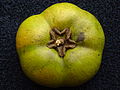 Black Sapote fruit
 -
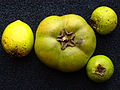 Black Sapote fruit
 -
 Black Sapote fruit
 -
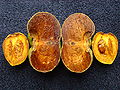 Black Sapote fruit
 -
 Black Sapote fruit


