Hemileia vastatrix: Difference between revisions
CSV import Tags: mobile edit mobile web edit |
CSV import |
||
| Line 19: | Line 19: | ||
[[Category:Coffee diseases]] | [[Category:Coffee diseases]] | ||
{{plant-disease-stub}} | {{plant-disease-stub}} | ||
== Hemileia_vastatrix == | |||
<gallery> | |||
File:Hemileia_vastatrix.jpg|Hemileia vastatrix | |||
File:Hemileia_vastatrix_-_coffee_leaf_rust.jpg|Hemileia vastatrix - coffee leaf rust | |||
File:Hemileia_vastatrix_uredinial_pustules.png|Hemileia vastatrix uredinial pustules | |||
File:Coffee-leaf-rust-defoliation.jpg|Coffee leaf rust defoliation | |||
</gallery> | |||
Latest revision as of 00:55, 27 February 2025

Hemileia vastatrix is a fungus species belonging to the genus Hemileia that is known for causing the plant disease known as coffee leaf rust. This disease has had significant impact on coffee production worldwide, affecting the livelihoods of millions of farmers and the global coffee industry. Hemileia vastatrix primarily affects plants in the genus Coffea, particularly Coffea arabica and Coffea canephora (robusta coffee).
Description[edit]
Hemileia vastatrix is characterized by the production of powdery orange to yellow spores on the undersides of coffee leaves. The infection leads to the formation of rust-colored lesions, which eventually cause defoliation, reduced vigor, and, in severe cases, the death of the coffee plant. The fungus is obligately parasitic, meaning it requires a living host to grow and reproduce. Its life cycle includes several stages, from spore germination to the development of uredinia, which are the spore-producing structures.
Life Cycle[edit]
The life cycle of Hemileia vastatrix is complex, involving several stages that are influenced by environmental conditions such as temperature and humidity. The fungus spreads primarily through wind-blown spores that infect new leaves. Moist conditions are necessary for spore germination and infection, making coffee plantations in humid regions particularly susceptible to outbreaks. Once a plant is infected, the fungus can rapidly spread, leading to widespread epidemics under favorable conditions.
Impact[edit]
The impact of coffee leaf rust caused by Hemileia vastatrix has been profound. Since its first recorded outbreak in the 19th century, the disease has spread to virtually all coffee-producing regions of the world. It can cause significant yield losses and, in severe cases, can lead to the abandonment of coffee plantations. The economic consequences for coffee farmers and exporting countries can be devastating, leading to increased prices and decreased availability of coffee on the global market.
Management[edit]
Managing coffee leaf rust involves an integrated approach that includes the use of resistant coffee varieties, cultural practices to reduce humidity and spore spread, and the application of fungicides. Breeding resistant varieties of coffee is considered one of the most sustainable long-term strategies, but it is challenged by the genetic diversity of Hemileia vastatrix and its ability to overcome resistance. Cultural practices, such as pruning and spacing of plants to improve air circulation, can help reduce the conditions favorable to the fungus's spread. Fungicides can be effective but require careful management to avoid the development of resistance and to minimize environmental impact.
Research[edit]
Ongoing research into Hemileia vastatrix and coffee leaf rust focuses on understanding the biology and genetics of the fungus, developing resistant coffee varieties, and improving management practices. Advances in genomics and biotechnology offer new opportunities to enhance resistance in coffee plants and to develop more effective and sustainable control strategies.

This article is a plant disease stub. You can help WikiMD by expanding it!
Hemileia_vastatrix[edit]
-
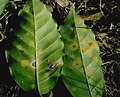 Hemileia vastatrix
 -
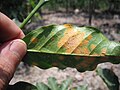 Hemileia vastatrix - coffee leaf rust
 -
 Hemileia vastatrix uredinial pustules
 -
 Coffee leaf rust defoliation


