Sodium trimetaphosphate: Difference between revisions
CSV import |
CSV import |
||
| Line 31: | Line 31: | ||
{{Chem-stub}} | {{Chem-stub}} | ||
<gallery> | |||
File:Sodium_trimetaphosphate.png|Sodium trimetaphosphate | |||
File:Na3P3O9(H2O)3(CollCode345).png|Sodium trimetaphosphate | |||
</gallery> | |||
Latest revision as of 01:31, 18 February 2025

Sodium trimetaphosphate (IUPAC name: sodium trioxido-1κO^4,1κO^5,1κO^6-triphosphate), is a chemical compound with the formula Na3P3O9. It is one of the sodium phosphates used in a variety of industrial and food applications. Sodium trimetaphosphate is a salt that consists of sodium ions and trimetaphosphate anions. It appears as a white, crystalline powder that is soluble in water, producing an alkaline solution.
Production[edit]
Sodium trimetaphosphate is produced by heating monosodium phosphate, NaH2PO4, or disodium phosphate, Na2HPO4, to high temperatures, which induces a condensation reaction that results in the formation of the trimetaphosphate ion, P3O9^3−.
Applications[edit]
Food Industry[edit]
In the food industry, sodium trimetaphosphate is utilized as an emulsifier, to improve the texture of processed foods, and as a sequestrant, helping to bind divalent metal ions. It is also used in the production of certain types of processed cheese, seafood products, and meat processing, where it acts as a water retention agent.
Industrial Uses[edit]
Beyond its applications in food, sodium trimetaphosphate finds use in various industrial processes. It serves as a dispersing agent in ceramics, detergents, and paints. Additionally, it is employed in water treatment as a sequestrant to remove hardness from water and in the oil industry for drilling fluids.
Health and Safety[edit]
The safety of sodium trimetaphosphate is overseen by food and health regulatory bodies, such as the U.S. Food and Drug Administration (FDA) and the European Food Safety Authority (EFSA), which evaluate its use in food and other products. While generally recognized as safe when used within prescribed limits, excessive intake of phosphates, including sodium trimetaphosphate, can lead to health issues, particularly in individuals with kidney problems or those at risk of developing kidney disease.
Environmental Impact[edit]
The environmental impact of sodium trimetaphosphate is similar to that of other phosphate salts. Its use in detergents and other applications can contribute to eutrophication in water bodies, leading to algal blooms and subsequent depletion of oxygen levels in aquatic environments. Therefore, its discharge into the environment is regulated in many jurisdictions.
See Also[edit]

-
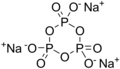 Sodium trimetaphosphate
 -
 Sodium trimetaphosphate
3(CollCode345).png)
