Polar regions of Earth: Difference between revisions
CSV import Tags: mobile edit mobile web edit |
CSV import |
||
| Line 30: | Line 30: | ||
{{Geography-stub}} | {{Geography-stub}} | ||
<gallery> | |||
File:Pulse_of_Snow_and_Sea_Ice.ogv|Animation showing the pulse of snow and sea ice in the polar regions | |||
File:Frozenground.gif|Animation of frozen ground in the polar regions | |||
File:Polar_Bear_2004-11-15.jpg|Polar bear in its natural habitat | |||
File:Pygoscelis_papua.jpg|Gentoo penguin in the polar regions | |||
</gallery> | |||
Latest revision as of 05:04, 18 February 2025
Polar regions of Earth refer to the areas surrounding the poles, specifically the Arctic in the north and the Antarctic in the south. These regions are characterized by extreme conditions, including low temperatures, unique ecosystems, and seasonal variations in daylight, ranging from 24-hour daylight in summer to complete darkness in winter.
Geography[edit]
The Arctic encompasses the area around the North Pole, including parts of Canada, Russia, Greenland, Norway, the United States (Alaska), Finland, Sweden, and Iceland. The Antarctic, on the other hand, is centered around the South Pole and is primarily composed of the continent of Antarctica.
Climate[edit]
The climate in the polar regions is generally cold, though the Arctic experiences some seasonal variations that can lead to relatively mild summers. The Antarctic is colder, with temperatures in the interior falling below -80°C (-112°F) in winter. Both regions are subject to extreme weather events, including blizzards and ice storms.
Ecosystems[edit]
Despite the harsh conditions, both the Arctic and Antarctic are home to diverse ecosystems. The Arctic is known for its tundra, where species such as the polar bear, Arctic fox, and various seabirds can be found. The Antarctic ecosystem is largely marine, with penguins, seals, and whales playing significant roles.
Human Presence[edit]
Human activity in the polar regions has historically been limited due to the extreme conditions. However, there are indigenous peoples in the Arctic, such as the Inuit, who have adapted to the harsh environment over thousands of years. The Antarctic does not have an indigenous human population, and human activity there is mostly related to research and tourism.
Environmental Concerns[edit]
The polar regions are particularly sensitive to the effects of climate change. Melting ice caps, permafrost thawing, and changes in sea levels are significant concerns. These changes also have implications for global weather patterns and biodiversity.
Research and Exploration[edit]
Both the Arctic and Antarctic have been subjects of extensive research and exploration. Scientific research stations in these regions study a wide range of topics, including climate science, glaciology, and marine biology. Historical expeditions to the poles are notable for their feats of endurance and discovery.
See Also[edit]

-
 Animation showing the pulse of snow and sea ice in the polar regions
 -
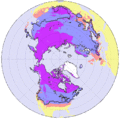 Animation of frozen ground in the polar regions
 -
 Polar bear in its natural habitat
 -
 Gentoo penguin in the polar regions


