Electron therapy: Difference between revisions
CSV import Tags: mobile edit mobile web edit |
CSV import |
||
| (2 intermediate revisions by the same user not shown) | |||
| Line 1: | Line 1: | ||
'''Electron therapy''' | '''Electron therapy''' is a type of [[radiation therapy]] that uses [[electrons]] to treat superficial tumors. It is a form of [[external beam radiation therapy]] that is particularly effective for treating [[skin cancer]], [[lymph nodes]], and tumors that are near the surface of the body. | ||
== | === Principles of Electron Therapy === | ||
Electron therapy utilizes high-energy electrons, typically in the range of 6 to 20 MeV, to deliver radiation doses to the target tissue. The unique characteristic of electrons is their ability to deposit energy at a specific depth, which is determined by their initial energy. This property allows for the sparing of deeper tissues, making electron therapy ideal for treating superficial lesions. | |||
The [[dose distribution]] of electron beams is characterized by a rapid dose fall-off beyond the target depth, as illustrated in the dose depth curves. This feature minimizes the exposure of underlying healthy tissues to radiation, reducing potential side effects. | |||
==Applications== | === Applications === | ||
Electron therapy is commonly used in the treatment of: | |||
== | * [[Basal cell carcinoma]] and [[squamous cell carcinoma]] of the skin | ||
* [[Keloids]] | |||
* [[Mycosis fungoides]] | |||
* [[Breast cancer]] post-mastectomy chest wall irradiation | |||
* [[Lymphoma]] | |||
=== Advantages and Limitations === | |||
The primary advantage of electron therapy is its ability to deliver a high dose to superficial tumors while sparing deeper tissues. This makes it particularly useful for treating cancers that are located close to the skin surface. | |||
However, electron therapy has limitations, including: | |||
* Limited penetration depth, making it unsuitable for deep-seated tumors | |||
* Difficulty in treating irregularly shaped tumors due to the uniformity of the electron beam | |||
=== Treatment Planning === | |||
Treatment planning for electron therapy involves determining the appropriate energy level and field size to ensure adequate coverage of the tumor while minimizing exposure to surrounding healthy tissue. [[Bolus]] material may be used to bring the dose closer to the skin surface or to compensate for tissue irregularities. | |||
=== Equipment === | |||
Electron therapy is delivered using a [[linear accelerator]] (linac), which accelerates electrons to the desired energy level. The linac is equipped with a [[multileaf collimator]] to shape the beam and a [[treatment couch]] to position the patient accurately. | |||
== Related Pages == | |||
* [[Radiation therapy]] | |||
* [[Linear accelerator]] | |||
* [[External beam radiation therapy]] | |||
* [[Skin cancer]] | |||
[[Category:Radiation therapy]] | [[Category:Radiation therapy]] | ||
==Electron_therapy== | |||
<gallery> | |||
File:Dose_Depth_Curves.svg|Dose Depth Curves | |||
</gallery> | |||
Latest revision as of 21:39, 20 February 2025
Electron therapy is a type of radiation therapy that uses electrons to treat superficial tumors. It is a form of external beam radiation therapy that is particularly effective for treating skin cancer, lymph nodes, and tumors that are near the surface of the body.
Principles of Electron Therapy[edit]
Electron therapy utilizes high-energy electrons, typically in the range of 6 to 20 MeV, to deliver radiation doses to the target tissue. The unique characteristic of electrons is their ability to deposit energy at a specific depth, which is determined by their initial energy. This property allows for the sparing of deeper tissues, making electron therapy ideal for treating superficial lesions.
The dose distribution of electron beams is characterized by a rapid dose fall-off beyond the target depth, as illustrated in the dose depth curves. This feature minimizes the exposure of underlying healthy tissues to radiation, reducing potential side effects.
Applications[edit]
Electron therapy is commonly used in the treatment of:
- Basal cell carcinoma and squamous cell carcinoma of the skin
- Keloids
- Mycosis fungoides
- Breast cancer post-mastectomy chest wall irradiation
- Lymphoma
Advantages and Limitations[edit]
The primary advantage of electron therapy is its ability to deliver a high dose to superficial tumors while sparing deeper tissues. This makes it particularly useful for treating cancers that are located close to the skin surface.
However, electron therapy has limitations, including:
- Limited penetration depth, making it unsuitable for deep-seated tumors
- Difficulty in treating irregularly shaped tumors due to the uniformity of the electron beam
Treatment Planning[edit]
Treatment planning for electron therapy involves determining the appropriate energy level and field size to ensure adequate coverage of the tumor while minimizing exposure to surrounding healthy tissue. Bolus material may be used to bring the dose closer to the skin surface or to compensate for tissue irregularities.
Equipment[edit]
Electron therapy is delivered using a linear accelerator (linac), which accelerates electrons to the desired energy level. The linac is equipped with a multileaf collimator to shape the beam and a treatment couch to position the patient accurately.
Related Pages[edit]
Electron_therapy[edit]
-
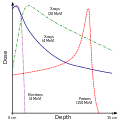 Dose Depth Curves

