Davis's law: Difference between revisions
CSV import Tags: mobile edit mobile web edit |
CSV import |
||
| Line 1: | Line 1: | ||
{{DISPLAYTITLE:Davis's Law}} | |||
== | == Davis's Law == | ||
Davis's Law | [[File:Davis's_law.tif|thumb|right|Illustration of Davis's Law]] | ||
'''Davis's Law''' is a principle in [[anatomy]] and [[physiology]] that describes how [[soft tissue]]s, such as [[muscle]]s, [[tendon]]s, and [[ligament]]s, adapt to the mechanical demands placed upon them. This law is named after [[Henry Gassett Davis]], an American orthopedic surgeon who first described the phenomenon in the 19th century. | |||
== | == Principle == | ||
Davis's Law states that soft tissues will remodel and adapt in response to the mechanical stresses they experience. When tissues are subjected to increased stress, they will become stronger and more resilient. Conversely, if the stress is reduced, the tissues will become weaker and less dense. This principle is similar to [[Wolff's Law]], which applies to [[bone]]s. | |||
== Mechanism == | |||
The adaptation of soft tissues according to Davis's Law involves several biological processes: | |||
* '''Collagen Synthesis''': Increased mechanical stress stimulates the production of [[collagen]], a primary structural protein in connective tissues. | |||
[[ | * '''Cellular Response''': [[Fibroblast]]s and other cells in the tissue respond to mechanical signals by altering their activity, leading to changes in tissue structure and function. | ||
* '''Matrix Remodeling''': The [[extracellular matrix]] undergoes remodeling to accommodate the new mechanical demands, enhancing the tissue's ability to withstand stress. | |||
== | == Applications == | ||
Davis's Law has important implications in various fields, including: | |||
* '''[[Physical therapy]]''': Understanding how tissues adapt to stress is crucial for designing effective rehabilitation programs. | |||
* '''[[Sports medicine]]''': Athletes use principles derived from Davis's Law to optimize training regimens and prevent injuries. | |||
* '''[[Orthopedics]]''': Surgeons and clinicians apply this knowledge to improve outcomes in surgical procedures and recovery. | |||
== | == Limitations == | ||
Davis's Law | While Davis's Law provides a useful framework for understanding tissue adaptation, it is important to recognize its limitations: | ||
* '''Individual Variability''': The rate and extent of tissue adaptation can vary significantly between individuals. | |||
* '''Overuse Injuries''': Excessive stress can lead to [[overuse injury|overuse injuries]], where tissues are damaged faster than they can adapt. | |||
== Related Pages == | |||
* [[Wolff's Law]] | |||
* [[Physical therapy]] | |||
* [[Orthopedics]] | |||
* [[Sports medicine]] | |||
[[Category:Anatomy]] | [[Category:Anatomy]] | ||
[[Category:Physiology]] | [[Category:Physiology]] | ||
[[Category:Orthopedics]] | [[Category:Orthopedics]] | ||
Latest revision as of 03:33, 13 February 2025
Davis's Law[edit]
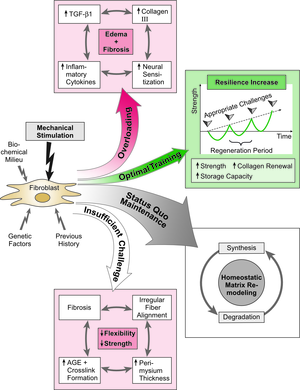
Davis's Law is a principle in anatomy and physiology that describes how soft tissues, such as muscles, tendons, and ligaments, adapt to the mechanical demands placed upon them. This law is named after Henry Gassett Davis, an American orthopedic surgeon who first described the phenomenon in the 19th century.
Principle[edit]
Davis's Law states that soft tissues will remodel and adapt in response to the mechanical stresses they experience. When tissues are subjected to increased stress, they will become stronger and more resilient. Conversely, if the stress is reduced, the tissues will become weaker and less dense. This principle is similar to Wolff's Law, which applies to bones.
Mechanism[edit]
The adaptation of soft tissues according to Davis's Law involves several biological processes:
- Collagen Synthesis: Increased mechanical stress stimulates the production of collagen, a primary structural protein in connective tissues.
- Cellular Response: Fibroblasts and other cells in the tissue respond to mechanical signals by altering their activity, leading to changes in tissue structure and function.
- Matrix Remodeling: The extracellular matrix undergoes remodeling to accommodate the new mechanical demands, enhancing the tissue's ability to withstand stress.
Applications[edit]
Davis's Law has important implications in various fields, including:
- Physical therapy: Understanding how tissues adapt to stress is crucial for designing effective rehabilitation programs.
- Sports medicine: Athletes use principles derived from Davis's Law to optimize training regimens and prevent injuries.
- Orthopedics: Surgeons and clinicians apply this knowledge to improve outcomes in surgical procedures and recovery.
Limitations[edit]
While Davis's Law provides a useful framework for understanding tissue adaptation, it is important to recognize its limitations:
- Individual Variability: The rate and extent of tissue adaptation can vary significantly between individuals.
- Overuse Injuries: Excessive stress can lead to overuse injuries, where tissues are damaged faster than they can adapt.
