Phase (matter): Difference between revisions
CSV import |
CSV import |
||
| Line 43: | Line 43: | ||
{{thermodynamics-stub}} | {{thermodynamics-stub}} | ||
{{matter-stub}} | {{matter-stub}} | ||
<gallery> | |||
File:Argon_ice_1.jpg|Argon ice | |||
File:Iron_carbon_phase_diagram.svg|Iron-carbon phase diagram | |||
File:phase-diag2.svg|Phase diagram | |||
</gallery> | |||
Latest revision as of 01:36, 18 February 2025
Phase (matter)
In the field of physics, a phase refers to a distinct form of matter characterized by its state, physical properties, and the transitions between them. The term is derived from the Greek word phasis, meaning "appearance" or "aspect". The most common phases of matter are solid, liquid, and gas, with plasma being the fourth state of matter.
Overview[edit]
A phase is defined by the thermodynamic state of a system, which includes variables such as temperature, pressure, and volume. The phase of a substance can change through phase transitions, such as melting, freezing, vaporization, condensation, sublimation, and deposition.
Phases of Matter[edit]
Solid[edit]
A solid is a phase of matter characterized by its rigidity and resistance to changes in shape or volume. The atoms or molecules in a solid are closely packed together and vibrate about their average positions.
Liquid[edit]
A liquid is a phase of matter that flows and takes the shape of its container, except for the surface area, which remains free. The particles in a liquid are closely packed, but they can move freely, allowing liquids to flow.
Gas[edit]
A gas is a phase of matter that expands to fill any available space. The particles in a gas are far apart and move freely, resulting in a lack of definite shape or volume.
Plasma[edit]
Plasma is often considered the fourth state of matter. It is an ionized gas, meaning it contains free electrons and ions. Plasmas are found in stars and in the Earth's atmosphere during a lightning storm.
Phase Transitions[edit]
A phase transition is the transformation of a thermodynamic system from one phase to another. The types of phase transitions include melting, freezing, vaporization, condensation, sublimation, and deposition.
See Also[edit]


This article is a thermodynamics-related stub. You can help WikiMD by expanding it!
This matter-related article is a stub. You can help WikiMD by expanding it.
-
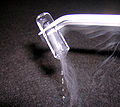 Argon ice
 -
 Iron-carbon phase diagram
 -
 Phase diagram


