Mertansine: Difference between revisions
CSV import Tags: mobile edit mobile web edit |
CSV import |
||
| Line 27: | Line 27: | ||
{{pharmacology-stub}} | {{pharmacology-stub}} | ||
== Mertansine == | |||
<gallery> | |||
File:Mertansine mab structure coloured.svg|Mertansine | |||
File:Emtansine mab structure coloured.svg|Emtansine | |||
</gallery> | |||
Latest revision as of 01:49, 20 February 2025
Mertansine is a cytotoxic agent used in the creation of antibody-drug conjugates (ADCs). It is also known by its chemical name, DM1, and is derived from maytansinoids, a group of compounds related to maytansine.
Chemistry[edit]
Mertansine is a maytansinoid, a type of ansamycin antibiotic. It is a potent microtubule-disrupting agent, which prevents the formation of the mitotic spindle, thereby inhibiting cell division. This makes it a useful tool in the treatment of rapidly dividing cancer cells.
Use in Medicine[edit]
In the field of oncology, mertansine is used as a cytotoxic component of antibody-drug conjugates. These are designed to deliver the cytotoxic agent directly to cancer cells, thereby reducing the impact on healthy cells. One such ADC is Trastuzumab emtansine, which combines mertansine with the monoclonal antibody trastuzumab.
Pharmacology[edit]
Mertansine works by binding to tubulin, a protein that forms the microtubules necessary for cell division. By preventing the formation of these microtubules, mertansine inhibits the process of mitosis, leading to cell death.
Safety and Side Effects[edit]
Like all cytotoxic agents, mertansine can have serious side effects. These can include nausea, vomiting, hair loss, and myelosuppression. It is therefore important that mertansine is used under the supervision of a healthcare professional.
See Also[edit]
References[edit]
<references />

Mertansine[edit]
-
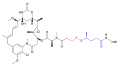 Mertansine
 -
 Emtansine


