Beta3-adrenergic agonist: Difference between revisions
CSV import Tags: mobile edit mobile web edit |
CSV import |
||
| Line 32: | Line 32: | ||
{{pharmacology-stub}} | {{pharmacology-stub}} | ||
<gallery> | |||
File:Mirabegron.svg|Mirabegron | |||
File:Solabegron.svg|Solabegron | |||
File:Vibegron.svg|Vibegron | |||
File:Phenylethanolamine.png|Phenylethanolamine | |||
File:Basic structure for beta 3 adrenergic receptor agonist.jpg|Basic structure for beta 3 adrenergic receptor agonist | |||
File:IUPAC - 3-(3-((2R)-2-((2-(3-chlorophenyl)-2-hydroxyethyl)amino)propyl)-1H-indol-7-yl)propanoic acid.jpg|IUPAC - 3-(3-((2R)-2-((2-(3-chlorophenyl)-2-hydroxyethyl)amino)propyl)-1H-indol-7-yl)propanoic acid | |||
File:IUPAC - N-(4-(2-((2-hydroxy-2-(pyridin-3-yl)ethyl)amino)ethyl)phenyl)-4-(4-(4-(trifluoromethyl)phenyl)thiazol-2-yl)benzenesulfonamide.jpg|IUPAC - N-(4-(2-((2-hydroxy-2-(pyridin-3-yl)ethyl)amino)ethyl)phenyl)-4-(4-(4-(trifluoromethyl)phenyl)thiazol-2-yl)benzenesulfonamide | |||
File:IUPAC - 2-(2-aminothiazol-4-yl)-N-(4-(((2S,5R)-5-(hydroxy(phenyl)methyl)pyrrolidin-2-yl)methyl)phenyl)acetamide.jpg|IUPAC - 2-(2-aminothiazol-4-yl)-N-(4-(((2S,5R)-5-(hydroxy(phenyl)methyl)pyrrolidin-2-yl)methyl)phenyl)acetamide | |||
File:IUPAC - 2-(2-aminothiazol-4-yl)-N-(4-(((2S,5R)-5-(hydroxy(phenyl)methyl)pyrrolidin-2-yl)methyl)phenyl)propanamide.jpg|IUPAC - 2-(2-aminothiazol-4-yl)-N-(4-(((2S,5R)-5-(hydroxy(phenyl)methyl)pyrrolidin-2-yl)methyl)phenyl)propanamide | |||
File:IUPAC - 2-(2-aminothiazol-4-yl)-N-(4-(((2S,5R)-5-(hydroxy(phenyl)methyl)pyrrolidin-2-yl)methyl)phenyl)butanamide.jpg|IUPAC - 2-(2-aminothiazol-4-yl)-N-(4-(((2S,5R)-5-(hydroxy(phenyl)methyl)pyrrolidin-2-yl)methyl)phenyl)butanamide | |||
</gallery> | |||
Latest revision as of 06:16, 3 March 2025
Beta3-adrenergic agonist is a type of pharmacological agent that primarily stimulates beta-3 adrenergic receptors. These receptors are predominantly found in adipose tissue and the gastrointestinal tract, but are also present in the heart and bladder.
Mechanism of Action[edit]
Beta3-adrenergic agonists work by binding to beta-3 adrenergic receptors, which are part of the G protein-coupled receptor family. Upon activation, these receptors stimulate adenylate cyclase to convert ATP into cyclic AMP (cAMP). This increase in cAMP activates protein kinase A, which in turn triggers a series of intracellular events leading to the desired physiological response.
Therapeutic Uses[edit]
Beta3-adrenergic agonists have several potential therapeutic uses. They are being investigated for their potential to treat obesity and type 2 diabetes due to their ability to increase lipolysis and thermogenesis in adipose tissue. They are also used in the treatment of overactive bladder due to their ability to relax the detrusor muscle.
Side Effects[edit]
Like all pharmacological agents, beta3-adrenergic agonists can cause side effects. These may include nausea, vomiting, headache, and palpitations. However, these side effects are generally mild and transient.
Examples[edit]
Examples of beta3-adrenergic agonists include mirabegron and solabegron, which are used in the treatment of overactive bladder.
See Also[edit]
References[edit]
<references />

-
 Mirabegron
 -
 Solabegron
 -
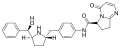 Vibegron
 -
 Phenylethanolamine
 -
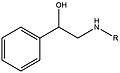 Basic structure for beta 3 adrenergic receptor agonist
 -
 IUPAC - 3-(3-((2R)-2-((2-(3-chlorophenyl)-2-hydroxyethyl)amino)propyl)-1H-indol-7-yl)propanoic acid
 -
 IUPAC - N-(4-(2-((2-hydroxy-2-(pyridin-3-yl)ethyl)amino)ethyl)phenyl)-4-(4-(4-(trifluoromethyl)phenyl)thiazol-2-yl)benzenesulfonamide
 -
 IUPAC - 2-(2-aminothiazol-4-yl)-N-(4-(((2S,5R)-5-(hydroxy(phenyl)methyl)pyrrolidin-2-yl)methyl)phenyl)acetamide
 -
 IUPAC - 2-(2-aminothiazol-4-yl)-N-(4-(((2S,5R)-5-(hydroxy(phenyl)methyl)pyrrolidin-2-yl)methyl)phenyl)propanamide
 -
 IUPAC - 2-(2-aminothiazol-4-yl)-N-(4-(((2S,5R)-5-(hydroxy(phenyl)methyl)pyrrolidin-2-yl)methyl)phenyl)butanamide


-2-((2-(3-chlorophenyl)-2-hydroxyethyl)amino)propyl)-1H-indol-7-yl)propanoic_acid.jpg)
ethyl)amino)ethyl)phenyl)-4-(4-(4-(trifluoromethyl)phenyl)thiazol-2-yl)benzenesulfonamide.jpg)
-N-(4-(((2S,5R)-5-(hydroxy(phenyl)methyl)pyrrolidin-2-yl)methyl)phenyl)acetamide.jpg)
-N-(4-(((2S,5R)-5-(hydroxy(phenyl)methyl)pyrrolidin-2-yl)methyl)phenyl)propanamide.jpg)
-N-(4-(((2S,5R)-5-(hydroxy(phenyl)methyl)pyrrolidin-2-yl)methyl)phenyl)butanamide.jpg)
