Citrus × sinensis: Difference between revisions
CSV import Tags: mobile edit mobile web edit |
CSV import |
||
| Line 25: | Line 25: | ||
[[Category:Hybrid plants]] | [[Category:Hybrid plants]] | ||
{{Citrus-stub}} | {{Citrus-stub}} | ||
<gallery> | |||
File:OrangeBloss_wb.jpg|Orange blossoms | |||
File:Orangerie_du_château_de_Versailles_le_11_septembre_2015_-_84.jpg|Orangerie at the Château de Versailles | |||
File:Orange_flowers_-_Portakal_çiçekleri_03.jpg|Orange flowers | |||
File:Unripened_orange.JPG|Unripened orange | |||
File:Oranges_and_blood_oranges_(01).jpg|Oranges and blood oranges | |||
File:Arancia_di_Ribera_byFigiu.JPG|Arancia di Ribera | |||
File:Apfelsinenbaum--Orange_tree.jpg|Orange tree | |||
File:Laranxeira_Naranjo_GFDL.JPG|Laranxeira Naranjo | |||
</gallery> | |||
Latest revision as of 11:37, 18 February 2025
Citrus × sinensis, commonly known as the sweet orange, is a hybrid of Citrus maxima (pomelo) and Citrus reticulata (mandarin). It is the most commonly grown tree fruit in the world.
Taxonomy[edit]
The binomial name Citrus × sinensis denotes its hybrid status – the '×' symbol indicates a hybrid. The sweet orange is a member of the Rutaceae family, which also includes other citrus fruits like lemons, limes, and grapefruits.
Description[edit]
The sweet orange tree is an evergreen, flowering tree, with an average height of 9 to 10 m (30 to 33 ft), although some very old specimens can reach 15 m (49 ft). Its oval leaves, alternately arranged, are 4 to 10 cm (1.6 to 3.9 in) long and have crenulate margins. The sweet orange has a compact and round crown.
Cultivation[edit]
Sweet orange trees thrive in a wide range of soil conditions, but prefer well-drained, sandy loam soils. They are propagated by grafting onto rootstocks. The trees are usually grown in orchards and are harvested in the winter months.
Uses[edit]
Sweet oranges are primarily grown for their fruit, which is eaten fresh or processed to extract orange juice. The peel is also used in certain recipes as a flavoring or garnish, and the volatile oil it contains is used in perfumery and as a flavoring.
Health benefits[edit]
Sweet oranges are a good source of vitamin C and other nutrients. They also contain dietary fiber and are low in calories, making them a healthy choice for a snack.
See also[edit]

-
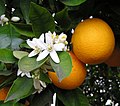 Orange blossoms
 -
 Orangerie at the Château de Versailles
 -
 Orange flowers
 -
 Unripened orange
 -
 Oranges and blood oranges
 -
 Arancia di Ribera
 -
 Orange tree
 -
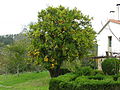 Laranxeira Naranjo


.jpg)


