Toona sinensis: Difference between revisions
CSV import Tags: mobile edit mobile web edit |
CSV import |
||
| Line 25: | Line 25: | ||
{{medicinal-plants-stub}} | {{medicinal-plants-stub}} | ||
{{edible-plants-stub}} | {{edible-plants-stub}} | ||
<gallery> | |||
File:ToonaSinensis.jpg|Toona sinensis leaves | |||
File:Toona_sinensis.jpg|Toona sinensis tree | |||
File:Toona_'Flamingo'.jpg|Toona 'Flamingo' cultivar | |||
File:A_Toona_sinensis_tree.jpg|A Toona sinensis tree | |||
File:Toona_sinensis_MHNT.BOT.2010.12.11.jpg|Toona sinensis specimen | |||
File:ToonaSinensisBark.jpg|Toona sinensis bark | |||
</gallery> | |||
Latest revision as of 11:10, 18 February 2025
Toona sinensis is a species of tree in the mahogany family, Melicaceae, native to eastern and southeastern Asia, from North Korea south through most of eastern, central and southwestern China to Nepal, northeastern India, Myanmar, Thailand, Malaysia, and western Indonesia.
Description[edit]
Toona sinensis is a deciduous tree growing to 25 meters tall with a trunk up to 70 cm diameter. The bark is brown, smooth on young trees, becoming scaly to shaggy on old trees. The leaves are pinnate, 50-70 cm long and 30-40 cm broad, with 10-40 leaflets, the terminal leaflet usually absent; the individual leaflets 9-15 cm long and 2.5-4 cm broad, with an entire or weakly serrated margin. The flowers are produced in summer in panicles 30-50 cm long at the end of a branch; each flower is small, 4-5 mm diameter, with five white or pale pink petals. The fruit is a capsule 2-3.5 cm long, containing several winged seeds.
Cultivation and uses[edit]
Toona sinensis is cultivated for its timber in many parts of Asia, including China, India, and Southeast Asia. It is also grown for its edible young leaves and shoots, known as xiangchun in China and used as a seasonal vegetable. The wood is also used for furniture and carving.
Medicinal uses[edit]
In traditional Chinese medicine, Toona sinensis is used for its anti-inflammatory, anti-tumor, and antiviral properties. It is also used to treat a variety of conditions, including fever, cough, and skin diseases.
Conservation status[edit]
Toona sinensis is not currently considered to be at risk of extinction, but its habitat is being lost due to deforestation and urbanization.
See also[edit]
This tree-related article is a stub. You can help WikiMD by expanding it.
This medicinal plants related article is a stub. You can help WikiMD by expanding it.
This edible plant-related article is a stub. You can help WikiMD by expanding it.
-
 Toona sinensis leaves
 -
 Toona sinensis tree
 -
 Toona 'Flamingo' cultivar
 -
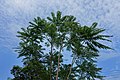 A Toona sinensis tree
 -
 Toona sinensis specimen
 -
 Toona sinensis bark


