Sonchus oleraceus: Difference between revisions
CSV import |
CSV import |
||
| Line 25: | Line 25: | ||
[[Category:Edible plants]] | [[Category:Edible plants]] | ||
{{Flora-stub}} | {{Flora-stub}} | ||
<gallery> | |||
File:Sonchus_February_2008-1.jpg|Sonchus oleraceus plant in February | |||
File:Leaf_of_Sonchus_oleraceus.png|Leaf of Sonchus oleraceus | |||
File:Flower_of_Sonchus_oleraceus.jpg|Flower of Sonchus oleraceus | |||
File:Amanida_de_lletsons9.JPG|Sonchus oleraceus salad | |||
</gallery> | |||
Latest revision as of 04:39, 18 February 2025
Sonchus oleraceus (commonly known as common sowthistle, smooth sow thistle, annual sow thistle, or milk thistle) is a plant species of the dandelion family and is considered a weed in some areas. It is native to Europe and Asia, but has been introduced to many other parts of the world.
Description[edit]
Sonchus oleraceus is an annual or biennial plant that can reach heights of up to 1 meter. It has a hollow, smooth stem that exudes a milky sap when broken. The leaves are alternate, simple, and can be lobed or unlobed. The flowers are yellow and are grouped in small clusters at the ends of the branches.
Distribution and habitat[edit]
Sonchus oleraceus is native to Europe and Asia, but has been introduced to many other parts of the world, including North America, Australia, and New Zealand. It is commonly found in disturbed areas, such as roadsides, fields, and waste places.
Uses[edit]
Despite being considered a weed in many areas, Sonchus oleraceus has a number of uses. The leaves, stems, and flowers can be eaten and are often used in salads or cooked as a vegetable. The plant is also used in traditional medicine for various ailments, including digestive problems, skin conditions, and respiratory issues.
Cultivation[edit]
Sonchus oleraceus is a hardy plant that can grow in a variety of conditions, but prefers well-drained soil and full sun. It is a prolific seeder and can quickly colonize disturbed areas.
See also[edit]
References[edit]
<references />

This flora-related article is a stub. You can help WikiMD by expanding it.
-
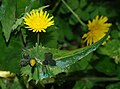 Sonchus oleraceus plant in February
 -
 Leaf of Sonchus oleraceus
 -
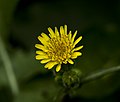 Flower of Sonchus oleraceus
 -
 Sonchus oleraceus salad


