Mixed tumor: Difference between revisions
CSV import |
CSV import |
||
| Line 42: | Line 42: | ||
[[Category:Medicine]] | [[Category:Medicine]] | ||
{{Medicine-stub}} | {{Medicine-stub}} | ||
<gallery> | |||
File:Histopathology of carcinosarcoma, annotated.png|Mixed tumor | |||
</gallery> | |||
Latest revision as of 01:35, 20 February 2025
Mixed Tumor
A Mixed Tumor is a type of neoplasm that contains more than one type of cellular differentiation. This term is most commonly used in the context of tumors of the salivary glands, but can also refer to tumors in other parts of the body.
Classification[edit]
Mixed tumors can be classified into two main types: pleomorphic adenoma and mucoepidermoid carcinoma.
Pleomorphic Adenoma[edit]
Pleomorphic adenoma, also known as benign mixed tumor, is the most common type of salivary gland tumor. It is characterized by a mixture of epithelial cells and myoepithelial cells.
Mucoepidermoid Carcinoma[edit]
Mucoepidermoid carcinoma is a type of mixed tumor that is typically malignant. It is characterized by a mixture of squamous cells, mucus-secreting cells, and intermediate cells.
Diagnosis[edit]
Diagnosis of mixed tumors typically involves a combination of physical examination, imaging studies, and biopsy. The exact diagnostic process may vary depending on the location of the tumor and the patient's symptoms.
Treatment[edit]
Treatment for mixed tumors depends on the type and location of the tumor, as well as the patient's overall health. Treatment options may include surgery, radiation therapy, and/or chemotherapy.
Prognosis[edit]
The prognosis for mixed tumors varies widely depending on factors such as the type of tumor, the stage at diagnosis, and the patient's overall health.
See Also[edit]
References[edit]
<references />

-
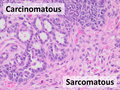 Mixed tumor

