Caulerpa lentillifera: Difference between revisions
CSV import |
CSV import |
||
| Line 23: | Line 23: | ||
[[Category:Marine flora of Asia]] | [[Category:Marine flora of Asia]] | ||
{{Algae-stub}} | {{Algae-stub}} | ||
<gallery> | |||
File:Tiny_Marine_Plant.jpg|Caulerpa lentillifera | |||
File:Umibudou_at_Miyakojima01s3s2850.jpg|Caulerpa lentillifera | |||
File:Ensaladang_Lato_(Seaweed_Salad)_-_Philippines_1.jpg|Caulerpa lentillifera | |||
File:Okinawa_sea_grape_on_sushi.jpg|Caulerpa lentillifera | |||
File:OceanGrapes.jpg|Caulerpa lentillifera | |||
File:USAID_Measuring_Impact_Conservation_Enterprise_Retrospective_(Philippines;_Nagkakaisang_Tribu_ng_Palawan)_(26420465388).jpg|Caulerpa lentillifera | |||
</gallery> | |||
Latest revision as of 11:32, 18 February 2025
Caulerpa lentillifera is a species of benthic marine algae in the family Caulerpaceae. It is commonly known as sea grapes or green caviar due to its unique grape-like appearance. This species is native to the Pacific Ocean, particularly in the coastal regions of Japan, Philippines, Vietnam, and Indonesia.
Description[edit]
Caulerpa lentillifera is characterized by its green, grape-like structure which is a result of its unique thallus formation. The thallus consists of a stolon that runs along the seafloor, with upright branches bearing spherical structures known as ramuli. The ramuli, resembling small grapes, are the most distinctive feature of this species.
Habitat and Distribution[edit]
Caulerpa lentillifera thrives in shallow, warm, and clear waters. It is commonly found in the intertidal zone, attached to sandy or muddy substrates. Its distribution spans across the Pacific Ocean, with significant populations in Japan, Philippines, Vietnam, and Indonesia.
Cultivation and Uses[edit]
Caulerpa lentillifera is cultivated extensively for its nutritional and culinary value. It is a popular ingredient in Japanese cuisine, where it is known as umibudo, and in Filipino cuisine, where it is known as ar-arosep or lato. The algae is rich in protein, vitamin A, vitamin C, and iodine, making it a nutritious addition to various dishes.
Conservation Status[edit]
While Caulerpa lentillifera is not currently listed as threatened or endangered, it is susceptible to the impacts of climate change, including ocean warming and acidification. Efforts are being made to ensure the sustainable cultivation and harvesting of this species.
See Also[edit]

-
 Caulerpa lentillifera
 -
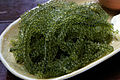 Caulerpa lentillifera
 -
 Caulerpa lentillifera
 -
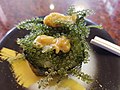 Caulerpa lentillifera
 -
 Caulerpa lentillifera
 -
 Caulerpa lentillifera


_-_Philippines_1.jpg)


_(26420465388).jpg)
