Blast furnace: Difference between revisions
CSV import Tags: mobile edit mobile web edit |
CSV import |
||
| Line 28: | Line 28: | ||
[[Category:Iron]] | [[Category:Iron]] | ||
{{Metallurgy-stub}} | {{Metallurgy-stub}} | ||
== Blast furnace gallery == | |||
<gallery> | |||
File:Alto Horno, Puerto de Sagunto, España, 2015-01-04, DD 91.JPG|Alto Horno, Puerto de Sagunto, España | |||
File:VysokePece1.jpg|Vysoke Pece | |||
File:Geography of Ohio - DPLA - aaba7b3295ff6973b6fd1e23e33cde14 (page 111) (cropped2).jpg|Geography of Ohio | |||
File:Blast Furnace Reactions.jpg|Blast Furnace Reactions | |||
File:Yuan Dynasty - waterwheels and smelting.png|Yuan Dynasty - waterwheels and smelting | |||
File:Chinese Fining and Blast Furnace.jpg|Chinese Fining and Blast Furnace | |||
File:HautfourneauXVIII 1nb.jpg|Hautfourneau XVIII | |||
File:Lohtaja.vaakuna.svg|Lohtaja | |||
File:Blast Furnaces at Blists Hill.jpg|Blast Furnaces at Blists Hill | |||
File:THC 2003.902.116 Charging the Experimental Blast Furnace.tif|Charging the Experimental Blast Furnace | |||
</gallery> | |||
Latest revision as of 06:01, 3 March 2025
Blast Furnace
A blast furnace is a type of metallurgical furnace used for smelting to produce industrial metals, generally pig iron, but also others such as lead or copper. The furnace operates by using heat from a controlled combustion process and the chemical reduction of iron-bearing materials to produce iron.
History[edit]
The use of blast furnaces dates back to the 5th century BC in China. The technology was later introduced to the Western world through the Middle East. The first blast furnace in Great Britain was built in 1491 near Bristol, during the reign of Henry VII.
Design and Function[edit]
A blast furnace is typically cylindrical in shape and made of steel. It is lined with refractory bricks that can withstand temperatures up to 2000 degrees Celsius. The furnace is filled with iron ore, coke, and limestone, and a hot blast of air is blown into the bottom of the furnace.
The hot air causes the coke to burn, producing carbon monoxide which reacts with the iron ore, reducing it to molten iron. The limestone acts as a flux, removing impurities from the iron.
Modern Blast Furnaces[edit]
Modern blast furnaces have improved on the traditional design by incorporating technology to increase efficiency and reduce environmental impact. These improvements include the use of top gas recycling, pulverized coal injection, and carbon capture and storage.
See Also[edit]

This article is a metallurgy-related stub. You can help WikiMD by expanding it!
Blast furnace gallery[edit]
-
 Alto Horno, Puerto de Sagunto, España
 -
 Vysoke Pece
 -
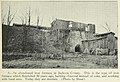 Geography of Ohio
 -
 Blast Furnace Reactions
 -
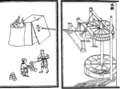 Yuan Dynasty - waterwheels and smelting
 -
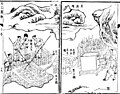 Chinese Fining and Blast Furnace
 -
 Hautfourneau XVIII
 -
 Lohtaja
 -
 Blast Furnaces at Blists Hill
 -
 Charging the Experimental Blast Furnace


_(cropped2).jpg)


