Brassica rapa: Difference between revisions
CSV import |
CSV import |
||
| (2 intermediate revisions by the same user not shown) | |||
| Line 1: | Line 1: | ||
==Brassica rapa== | |||
[[File:Leiden_University_Library_-_Seikei_Zusetsu_vol._25,_page_003_-_菜の花_-_Brassica_rapa_L.,_1804.jpg|thumb|right|Illustration of ''Brassica rapa'' from 1804]] | |||
'''''Brassica rapa''''' is a species of plant in the [[Brassicaceae]] family. It is a highly diverse species that includes various subspecies and varieties, many of which are cultivated as food crops. ''Brassica rapa'' is native to Europe and Asia and has been widely cultivated for its edible roots, leaves, and seeds. | |||
== | ==Description== | ||
''Brassica rapa'' is an annual or biennial plant that can grow up to 1 meter tall. The plant has a rosette of leaves at the base and a flowering stem that bears yellow flowers. The leaves are typically green, but some varieties have purple or red leaves. The root is usually white or yellow and can be round or elongated. | |||
==Cultivated Varieties== | |||
''Brassica rapa'' includes several important agricultural crops, each with distinct characteristics: | |||
'''Brassica rapa''' | * '''[[Turnip]]''' (''Brassica rapa'' subsp. ''rapa'') - Grown for its edible root and leaves. | ||
* '''[[Pak Choi]]''' (''Brassica rapa'' subsp. ''chinensis'') - A leafy vegetable popular in Asian cuisine. | |||
* '''[[Mizuna]]''' (''Brassica rapa'' var. ''nipposinica'') - Known for its feathery leaves and mild flavor. | |||
* '''[[Komatsuna]]''' (''Brassica rapa'' var. ''perviridis'') - Also known as Japanese mustard spinach. | |||
* '''[[Bomdong]]''' - A type of Korean cabbage. | |||
[[File:Baby_Pak_Choi_(01).JPG|thumb|left|Baby Pak Choi, a variety of ''Brassica rapa'']] | |||
==Uses== | |||
== | ''Brassica rapa'' is cultivated for various purposes: | ||
* '''Culinary Uses:''' The leaves, stems, and roots of ''Brassica rapa'' are consumed in many cultures. They can be eaten raw, cooked, or pickled. | |||
* '''Animal Feed:''' Some varieties are grown as fodder for livestock. | |||
* '''Oil Production:''' The seeds of certain varieties are pressed to produce oil. | |||
==Cultivation== | |||
''Brassica rapa'' is a cool-season crop that prefers well-drained, fertile soil. It is typically sown in early spring or late summer. The plant requires regular watering and benefits from a balanced fertilizer. | |||
[[File:Bomdong_cabbage.jpg|thumb|right|Bomdong cabbage, a Korean variety of ''Brassica rapa'']] | |||
==Pests and Diseases== | |||
''Brassica rapa'' is susceptible to several pests and diseases, including: | |||
* '''[[Cabbage worm]]s''' - Larvae that feed on the leaves. | |||
* '''[[Clubroot]]''' - A disease caused by the pathogen ''Plasmodiophora brassicae''. | |||
* '''[[Downy mildew]]''' - A fungal disease affecting the leaves. | |||
==Related Pages== | |||
* [[Brassicaceae]] | * [[Brassicaceae]] | ||
* [[ | * [[Cruciferous vegetables]] | ||
* [[List of vegetables]] | |||
[[File:Choi_Sum_stalks.JPG|thumb|left|Choi Sum stalks, another form of ''Brassica rapa'']] | |||
==Gallery== | |||
<gallery> | |||
File:Leiden_University_Library_-_Seikei_Zusetsu_vol._21,_page_014_-_菘_-_Brassica_rapa_L.,_1804.jpg|Historical illustration of ''Brassica rapa'' | |||
File:Brassica_rapa_ja02.jpg|''Brassica rapa'' plant | |||
File:Komatsuna.jpg|Komatsuna leaves | |||
File:Mizuna_001.jpg|Mizuna leaves | |||
</gallery> | |||
[[Category:Brassica]] | [[Category:Brassica]] | ||
[[Category: | [[Category:Leaf vegetables]] | ||
[[Category: | [[Category:Root vegetables]] | ||
Latest revision as of 11:29, 23 March 2025
Brassica rapa[edit]

Brassica rapa is a species of plant in the Brassicaceae family. It is a highly diverse species that includes various subspecies and varieties, many of which are cultivated as food crops. Brassica rapa is native to Europe and Asia and has been widely cultivated for its edible roots, leaves, and seeds.
Description[edit]
Brassica rapa is an annual or biennial plant that can grow up to 1 meter tall. The plant has a rosette of leaves at the base and a flowering stem that bears yellow flowers. The leaves are typically green, but some varieties have purple or red leaves. The root is usually white or yellow and can be round or elongated.
Cultivated Varieties[edit]
Brassica rapa includes several important agricultural crops, each with distinct characteristics:
- Turnip (Brassica rapa subsp. rapa) - Grown for its edible root and leaves.
- Pak Choi (Brassica rapa subsp. chinensis) - A leafy vegetable popular in Asian cuisine.
- Mizuna (Brassica rapa var. nipposinica) - Known for its feathery leaves and mild flavor.
- Komatsuna (Brassica rapa var. perviridis) - Also known as Japanese mustard spinach.
- Bomdong - A type of Korean cabbage.
.JPG)
Uses[edit]
Brassica rapa is cultivated for various purposes:
- Culinary Uses: The leaves, stems, and roots of Brassica rapa are consumed in many cultures. They can be eaten raw, cooked, or pickled.
- Animal Feed: Some varieties are grown as fodder for livestock.
- Oil Production: The seeds of certain varieties are pressed to produce oil.
Cultivation[edit]
Brassica rapa is a cool-season crop that prefers well-drained, fertile soil. It is typically sown in early spring or late summer. The plant requires regular watering and benefits from a balanced fertilizer.

Pests and Diseases[edit]
Brassica rapa is susceptible to several pests and diseases, including:
- Cabbage worms - Larvae that feed on the leaves.
- Clubroot - A disease caused by the pathogen Plasmodiophora brassicae.
- Downy mildew - A fungal disease affecting the leaves.
Related Pages[edit]

Gallery[edit]
-
 Historical illustration of Brassica rapa
 -
 Brassica rapa plant
 -
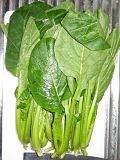 Komatsuna leaves
 -
 Mizuna leaves


