Bell metal: Difference between revisions
CSV import |
CSV import |
||
| Line 25: | Line 25: | ||
[[Category:Musical instruments]] | [[Category:Musical instruments]] | ||
{{metallurgy-stub}} | {{metallurgy-stub}} | ||
== Bell metal gallery == | |||
<gallery> | |||
File:Malik E Maidan.jpg|Malik E Maidan | |||
File:Jingyun bell.jpg|Jingyun bell | |||
</gallery> | |||
Latest revision as of 05:08, 3 March 2025
Bell metal is a type of bronze traditionally used for casting bells. It is a form of bronze with a high tin content, usually in the ratio of 78% copper to 22% tin. The high tin content increases the rigidity of the metal, and increases the resonance. It also has excellent casting properties, high wear resistance, and low corrosion.
History[edit]
The use of bell metal dates back to antiquity. It was widely used in ancient Rome and ancient Greece for the production of statues, coins, and bells. The Chinese also used bell metal in the production of their famous bells, some of which date back to the Shang Dynasty.
Production[edit]
The production of bell metal involves the alloying of copper and tin. The copper is first melted, and then the tin is added. The mixture is then poured into a mold to create the bell. The high tin content gives the bell its distinctive sound, which is different from that of a bell made from pure copper or bronze.
Uses[edit]
In addition to its use in bells, bell metal is also used in the production of cymbals and other percussion instruments. It is also used in the manufacture of high-quality cookware, due to its excellent heat conductivity and durability.
See also[edit]

This article is a metallurgy-related stub. You can help WikiMD by expanding it!
Bell metal gallery[edit]
-
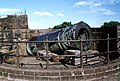 Malik E Maidan
 -
 Jingyun bell


