Animal glue: Difference between revisions
CSV import Tags: mobile edit mobile web edit |
CSV import |
||
| Line 36: | Line 36: | ||
{{Music-stub}} | {{Music-stub}} | ||
{{Art-stub}} | {{Art-stub}} | ||
<gallery> | |||
File:Knochenleim_Granulat.jpg|Granulated animal glue | |||
File:Bones_Wanted_Art.IWMPST14727.jpg|Bones Wanted poster | |||
File:Cold_glue.jpg|Cold animal glue | |||
File:Hot_glue.jpg|Hot animal glue | |||
</gallery> | |||
Latest revision as of 04:44, 18 February 2025
Animal glue is a type of adhesive that is derived from collagen, a protein found in animal tissues. It has been used for thousands of years in various forms, including as a binding agent in woodworking, in the production of musical instruments, and in the creation of fine art.
History[edit]
The use of animal glue dates back to ancient times. The Ancient Egyptians used it in their furniture and coffin construction, and it was also used in the Middle Ages for bookbinding and illuminated manuscripts. In the 18th and 19th centuries, animal glue was commonly used in the production of furniture and cabinet making.
Production[edit]
Animal glue is produced by boiling animal tissues, such as hide, bones, and hooves, in water. This process extracts the collagen, which is then dried and ground into a powder. The powder can be mixed with water to form a gel, which can be used as an adhesive.
Uses[edit]
Animal glue has a wide range of uses. In woodworking, it is used as a binding agent for veneer and marquetry. It is also used in the production of musical instruments, such as violins and guitars, where it is valued for its strength and flexibility. In the field of fine art, animal glue is used as a size to prepare canvas for oil painting, and as a component of gesso, a white paint mixture used in fresco and oil painting.
Advantages and Disadvantages[edit]
One of the main advantages of animal glue is its reversibility. This means that it can be softened and removed without damaging the materials it is adhered to. This makes it ideal for use in conservation and restoration work. However, animal glue is also susceptible to fungal and insect attack, and it can become brittle and lose its adhesive properties over time.
See Also[edit]
This adhesive related article is a stub. You can help WikiMD by expanding it.
This animal product related article is a stub. You can help WikiMD by expanding it.


-
 Granulated animal glue
 -
 Bones Wanted poster
 -
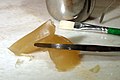 Cold animal glue
 -
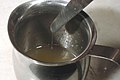 Hot animal glue


