Water conservation: Difference between revisions
CSV import |
CSV import |
||
| Line 31: | Line 31: | ||
{{Environment-stub}} | {{Environment-stub}} | ||
{{Sustainability-stub}} | {{Sustainability-stub}} | ||
<gallery> | |||
File:Water-conservation-stamp-1960.jpg|Water conservation stamp from 1960 | |||
File:VineyardDrip.JPG|Drip irrigation in a vineyard | |||
File:PivotIrrigationOnCotton.jpg|Pivot irrigation on a cotton field | |||
File:Leaking_garden_hose_bib.jpg|Leaking garden hose bib | |||
</gallery> | |||
Latest revision as of 04:48, 18 February 2025
Water conservation refers to the reduction of water usage, the protection of water quality, and the improvement of water management practices. It is a key component in sustainable development and environmental protection, and is crucial for ensuring the long-term availability of this vital resource.
Overview[edit]
Water conservation is a broad field that encompasses a variety of strategies and techniques. These can range from simple changes in behavior, such as taking shorter showers or turning off the tap while brushing teeth, to more complex measures like the installation of rainwater harvesting systems or the use of greywater for irrigation.
Importance[edit]
Water is a finite resource, and its conservation is essential for the survival of all life on Earth. It is also a critical factor in many human activities, including agriculture, industry, and domestic use. By conserving water, we can help to ensure that there is enough to meet the needs of both current and future generations.
Strategies[edit]
There are many different strategies for water conservation, which can be broadly categorized into two types: demand-side and supply-side measures.
Demand-side Measures[edit]
Demand-side measures aim to reduce the amount of water that is used. This can be achieved through a variety of methods, such as water-efficient appliances, water-saving technologies, and changes in behavior.
Supply-side Measures[edit]
Supply-side measures aim to increase the amount of available water. This can be done through methods such as water recycling, desalination, and rainwater harvesting.
Challenges[edit]
Despite the clear benefits of water conservation, there are many challenges to its implementation. These include a lack of awareness about the importance of water conservation, the cost of implementing water-saving measures, and the difficulty of changing established behaviors and practices.
See Also[edit]

This article is a water supply–related stub. You can help WikiMD by expanding it!

This article is a environment-related stub. You can help WikiMD by expanding it!

This article is a sustainability-related stub. You can help WikiMD by expanding it!
-
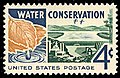 Water conservation stamp from 1960
 -
 Drip irrigation in a vineyard
 -
 Pivot irrigation on a cotton field
 -
 Leaking garden hose bib


