Poxviridae: Difference between revisions
CSV import Tags: mobile edit mobile web edit |
CSV import |
||
| Line 30: | Line 30: | ||
[[Category:DNA viruses]] | [[Category:DNA viruses]] | ||
{{Virus-stub}} | {{Virus-stub}} | ||
<gallery> | |||
File:Electron_micrograph_of_smallpox_virus.jpg|Electron micrograph of smallpox virus | |||
File:Electron_micrograph_of_poxvirus_particles_in_synovium_of_a_big_brown_bat_and_negative_staining_of_poxvirus_particles_in_cell_culture_supernatant.jpg|Electron micrograph of poxvirus particles in synovium of a big brown bat and negative staining of poxvirus particles in cell culture supernatant | |||
File:Poxviridae_virion.jpg|Poxviridae virion | |||
File:Poxviridae_cycle.jpg|Poxviridae cycle | |||
File:Journal.ppat.1009372.g001.png|Poxviridae | |||
</gallery> | |||
Latest revision as of 11:34, 18 February 2025
Poxviridae is a family of viruses known for causing diseases in both humans and animals. The family is divided into two subfamilies: Chordopoxvirinae, which infect vertebrates, and Entomopoxvirinae, which infect insects.
Taxonomy[edit]
The Poxviridae family is divided into two subfamilies: Chordopoxvirinae and Entomopoxvirinae. The Chordopoxvirinae subfamily is further divided into 18 genera, including Orthopoxvirus, Avipoxvirus, and Molluscipoxvirus. The Entomopoxvirinae subfamily is divided into three genera: Alphaentomopoxvirus, Betaentomopoxvirus, and Gammaentomopoxvirus.
Structure[edit]
Poxviruses are large, complex viruses with a unique brick or oval shape. They have a linear, double-stranded DNA genome, which is enclosed in a core surrounded by multiple layers of lipoprotein. The outermost layer is a membrane envelope derived from the host cell.
Replication[edit]
Poxviruses replicate in the cytoplasm of the host cell, a unique characteristic among DNA viruses. The replication process involves several stages, including entry, uncoating, early gene expression, DNA replication, late gene expression, assembly, and release.
Diseases[edit]
Poxviruses are responsible for several diseases in humans and animals. The most well-known is smallpox, caused by the variola virus, a member of the Orthopoxvirus genus. Other diseases caused by poxviruses include cowpox, monkeypox, and molluscum contagiosum.
Prevention and Treatment[edit]
Vaccination is the primary method of prevention for poxvirus diseases. The smallpox vaccine was the first vaccine ever developed and led to the eradication of smallpox. Treatment for poxvirus infections is primarily supportive, as there are currently no specific antiviral drugs for these viruses.
See Also[edit]

-
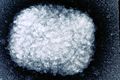 Electron micrograph of smallpox virus
 -
 Electron micrograph of poxvirus particles in synovium of a big brown bat and negative staining of poxvirus particles in cell culture supernatant
 -
 Poxviridae virion
 -
 Poxviridae cycle
 -
 Poxviridae


