Middle East: Difference between revisions
CSV import |
CSV import |
||
| Line 29: | Line 29: | ||
{{Asia-stub}} | {{Asia-stub}} | ||
{{Africa-stub}} | {{Africa-stub}} | ||
<gallery> | |||
File:Middle_East_(orthographic_projection).svg|Middle East (orthographic projection) | |||
File:Middle_east.jpg|Middle east | |||
File:Middle_East_map_of_Köppen_climate_classification.svg|Middle East map of Köppen climate classification | |||
File:Middle_East.ogv|Middle East | |||
File:Emblem_of_Turkey.svg|Emblem of Turkey | |||
File:All_Gizah_Pyramids.jpg|All Gizah Pyramids | |||
File:Göbekli_Tepe,_Urfa.jpg|Göbekli Tepe, Urfa | |||
File:Westernwall2.jpg|Western Wall | |||
File:Jerusalem-Grabeskirche-14-vom_Erloeserkirchturm-2010-gje.jpg|Jerusalem Grabeskirche | |||
File:Kaaba_mirror_edit_jj.jpg|Kaaba | |||
File:Maunsell's_map,_Pre-World_War_I_British_Ethnographical_Map_of_eastern_Turkey_in_Asia,_Syria_and_western_Persia_01.jpg|Maunsell's map, Pre-World War I British Ethnographical Map of eastern Turkey in Asia, Syria and western Persia | |||
File:Mosque.jpg|Mosque | |||
</gallery> | |||
Latest revision as of 21:15, 23 February 2025
Middle East is a transcontinental region in Afro-Eurasia which generally includes Western Asia (except for Transcaucasia), all of Egypt (mostly in North Africa), and Turkey (partly in Southeast Europe). The term has come into wider usage as a replacement of the term Near East (as opposed to the Far East) beginning in the early 20th century.
Geography[edit]
The Middle East is located at the junction of Eurasia, Africa and the Arabian peninsula and has significant geopolitical importance due to its vast reserves of oil and natural gas. The region is home to many unique geographical features, such as the Arabian Desert, the Zagros Mountains, and the Nile River.
History[edit]
The Middle East has a rich history dating back to ancient times. It is often referred to as the "Cradle of Civilization" because it is where some of the earliest civilizations, such as the Sumerians, Babylonians, and Ancient Egyptians, developed. The region has been a focal point for conflict and diplomacy for centuries, with many empires, such as the Ottoman Empire and the Persian Empire, rising and falling within its borders.
Culture[edit]
The Middle East is known for its diverse cultures, languages, and religions. The region is predominantly Islamic, but also has significant Christian, Jewish, and other religious communities. The Middle East has made significant contributions to art, literature, music, and cuisine, with dishes like falafel, hummus, and shawarma being popular worldwide.
Economy[edit]
The economy of the Middle East is diverse and includes both highly developed and emerging economies. The region is known for its oil and gas industry, with countries like Saudi Arabia, Iran, and Qatar being major global producers. However, other sectors, such as tourism, technology, and finance, are also significant.
Politics[edit]
The politics of the Middle East are complex and often contentious. The region is home to many different political systems, from monarchies to republics, and has been the site of numerous conflicts, including the Arab-Israeli conflict, the Iran-Iraq War, and the ongoing Syrian Civil War.
See also[edit]
- History of the Middle East
- Culture of the Middle East
- Economy of the Middle East
- Politics of the Middle East


-
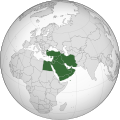 Middle East (orthographic projection)
 -
 Middle east
 -
 Middle East map of Köppen climate classification
 -
 Middle East
 -
 Emblem of Turkey
 -
 All Gizah Pyramids
 -
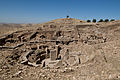 Göbekli Tepe, Urfa
 -
 Western Wall
 -
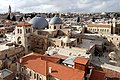 Jerusalem Grabeskirche
 -
 Kaaba
Kaaba -
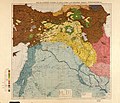 Maunsell's map, Pre-World War I British Ethnographical Map of eastern Turkey in Asia, Syria and western Persia
 -
 Mosque
.svg)


