Reactor-grade plutonium: Difference between revisions
CSV import |
CSV import |
||
| Line 26: | Line 26: | ||
[[Category:Nuclear proliferation]] | [[Category:Nuclear proliferation]] | ||
{{Nuclear-stub}} | {{Nuclear-stub}} | ||
<gallery> | |||
File:Sasahara.svg|Sasahara | |||
File:Trinity crater (annotated) 2.jpg|Trinity crater (annotated) | |||
File:RUTH test tower 1953-03-31.jpg|RUTH test tower 1953-03-31 | |||
File:Plutonium and uranium extraction from nuclear fuel-eng.svg|Plutonium and uranium extraction from nuclear fuel | |||
File:Ifr concept.jpg|IFR concept | |||
File:IFR concept.png|IFR concept | |||
File:RIAN archive 132603 Nuclear power reactor fuel assembly.jpg|Nuclear power reactor fuel assembly | |||
File:Nuclear dry storage.jpg|Nuclear dry storage | |||
</gallery> | |||
Latest revision as of 05:59, 3 March 2025
Reactor-grade plutonium is a type of plutonium that is produced in a nuclear reactor. It is distinguished from weapons-grade plutonium by its isotopic composition, which makes it less suitable for use in nuclear weapons but still useful for certain types of nuclear power generation.
Production[edit]
Reactor-grade plutonium is produced in a nuclear reactor when uranium-238 absorbs a neutron. This process creates plutonium-239, which is the primary isotope in weapons-grade plutonium. However, in a typical nuclear reactor, the plutonium-239 also absorbs neutrons and transforms into other isotopes of plutonium, including plutonium-240, plutonium-241, and plutonium-242. These isotopes are less suitable for use in nuclear weapons due to their higher rates of spontaneous fission, which can cause a weapon to pre-detonate and result in a lower yield.
Use in nuclear power[edit]
Despite its unsuitability for weapons use, reactor-grade plutonium can still be used in certain types of nuclear power generation. In particular, it can be used in fast breeder reactors, which are designed to create more fissile material than they consume. This is done by surrounding the reactor core with a "blanket" of uranium-238, which absorbs neutrons and transforms into plutonium. The plutonium can then be reprocessed and used as fuel, effectively extending the life of the uranium fuel supply.
Safety and proliferation concerns[edit]
While reactor-grade plutonium is less suitable for weapons use than weapons-grade plutonium, it is still possible to use it to create a nuclear weapon. However, such a weapon would be less reliable and have a lower yield than one made with weapons-grade plutonium. This has led to concerns about the potential for nuclear proliferation if reactor-grade plutonium were to fall into the wrong hands.
In addition, the reprocessing of reactor-grade plutonium presents safety and environmental challenges. The process involves handling highly radioactive materials and produces waste that must be safely stored for thousands of years. These issues have led some countries to abandon plutonium reprocessing and instead focus on once-through fuel cycles that do not involve reprocessing.
See also[edit]

This article is a nuclear physics or atomic physics–related stub. You can help WikiMD by expanding it!
-
 Sasahara
 -
 Trinity crater (annotated)
 -
 RUTH test tower 1953-03-31
 -
 Plutonium and uranium extraction from nuclear fuel
 -
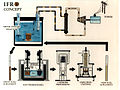 IFR concept
 -
 IFR concept
 -
 Nuclear power reactor fuel assembly
 -
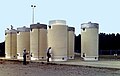 Nuclear dry storage

_2.jpg)


